

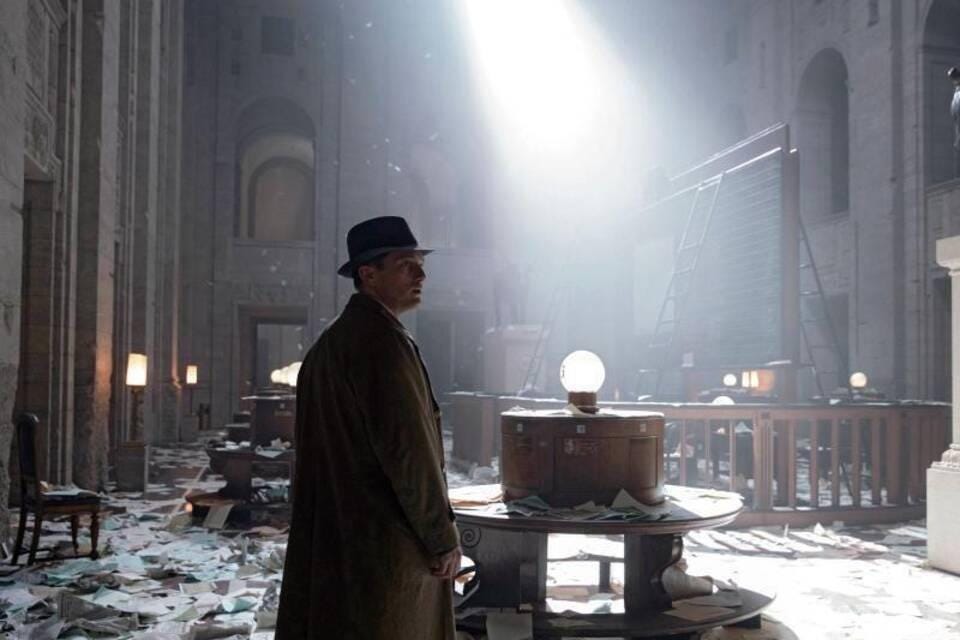
To watch Babylon Berlin is to enter a completed aesthetic and moral universe and test our own time against the layered sediment of a past that exploded. The distance is almost exactly a century—far enough for historical reassurance, but close enough for recognition.
The third season opens at the Berlin stock exchange during the crash of 1929, then turns the clock back five weeks before returning to the same collapse. Berlin continues to borrow, speculate, film and dance; the viewer has already watched the floor give way. The inherited world remains standing while, beneath its surfaces, another future is taking form.
Weimar itself was an aftermath. The Great War had damaged more than states and bodies. Ideas of progress, honour, Christian civilization, imperial legitimacy and technological mastery entered the trenches with the people who trusted them. The postwar world retained much of the old language and architecture, but they no longer carried the same reality.
Prewar Germany had not simply exhausted itself. Its industrial and scientific dynamism was straining inherited political forms. War turned those strains into a rupture whose consequences escaped the calculations of Europe’s leaders. The republic inherited the damage alongside the possibilities.
Gereon Rath’s body has not accepted the armistice. His hand trembles; morphine restores the appearance of ordinary time. Around him, Weimar gives new scope to democratic participation, cinema, psychoanalysis, sexual emancipation, changing roles for women and experiments in collective life. Its brilliance and fragility occupy the same opening.
At the Moka Efti, the performer Nikoros raises a hand and the gesture passes through the nightclub until the crowd moves as one body. Gender, eros, machinery, light and collective rhythm enter a choreography that unsettles inherited conventions. The freedom is real. So is the ambiguity. Human beings released from one form become available to others.
A civilizational container is more than a constraint. It is a time-bound mediation through which material, human and spiritual realities enter collective life. Families, religions, economies, rites and political institutions all perform this work, however imperfectly. They remain alive by adapting what they have received. Holding too tightly can also become a failure: some disruption is necessary for neglected capacities and unforeseen possibilities to acquire a place.
When a form mistakes its historical adequacy for completeness, new wine continues to arrive while the wineskin loses its elasticity. Blue Velvet cracks begin appearing through elevated surfaces, with real people already in pain beneath them. After the break, more than disorder is released. The collective shadow returns: injuries the old order concealed, but also capacities and truths it could no longer accommodate. These arrive entangled with resentment and unrealized futures. Their return does not establish their worth. Renaissance and catastrophe may begin at the same moment.
Recovering an inheritance is not the same as restoring the arrangement that failed to carry it. Weimar’s inventiveness belonged partly to that effort, but did not secure its institutions against the burdens they inherited or the forces working against them. The republic had to absorb defeat, bereavement, revolution, inflation and accelerated cultural change. The crash of 1929 arrived while the Great War was still active in bodies and institutions. One rupture had not finished before the next began. [1]
Money is never only money. Every transaction participates in a wider network of labour, trust, value and obligation. Older aristocracies often betrayed this relation, but noblesse oblige retained at least the principle that property, place, inheritance and duty belonged to one moral field.
Capital can leave; the obligations remain with the people and places from which it drew its value. Wealth becomes mobile while workers, families and consequences remain local. It can draw value from a society and then secede from the common world that made the value possible.
When wealth ceases to return as stewardship, protection, beauty, institutional continuity or a future held in common, inequality becomes a rupture in belonging. Those benefiting most from an order become insulated from its consequences. A transnational plutonomy does not quite govern a people; it arbitrages populations.
We can spend down an inheritance without recognizing what we owe it. Earlier generations gave their lives for freedoms their descendants experience as naturally occurring. As the world wars recede from living memory, inherited institutions can appear to have created themselves. This is not principally an accusation against the young. A civilization cannot expect people to honour a memory it has transmitted only as examination material, ritualized guilt or entertainment.
Money and memory both carry obligation through time. When wealth forgets the society that generated it, or the present forgets the sacrifices from which it received its freedom, the same relation has been severed. The present consumes a world it no longer recognizes as an inheritance.
The local sacred gives that obligation somewhere to be lived: a place where grief can be held, a promise honoured, an inheritance handed on. Its renewal requires people prepared to sustain such places and practices. Otherwise the sacred becomes another subject of cultural consumption. Even globally connected systems depend upon responsibilities that must be lived somewhere.
If those entrusted with power will not steward it, the cup is taken away. It does not necessarily pass to the worthy. It passes through the forms prepared to receive it.
In another age, the passage of the cup might have been understood as a movement among the gods. Yet effectiveness is not evidence of ultimate authority. What gathers symbolic force in Aeon and prevails in historical time, Chronos, does not therefore express Aion—the fuller order toward which it may claim to lead. Historical success can belong to a counterfeit totality: a partial form claiming the authority of the whole.
Choice and destiny meet here in ways no honest observer can fully separate. People act within conditions they did not choose. Emerging forms exert pressure, yet require institutions, money and human decisions before entering history. Retrospect makes the result appear inevitable. From within the opening, several futures may remain possible. Their capacity to gather people tells us less than what becomes of those people through participation: whether responsibility deepens or disappears into obedience. [2]
This is where Babylon Berlin becomes a recovered cycle rather than a simple historical analogy. Our present is not another Weimar, and history need not repeat its political content. The resemblance lies in the structure of a transformative interval. Technological and economic forces exceed the institutions intended to mediate them. Wealth separates from obligation, legitimacy thins, memory contracts, and new modes of intelligence and agency become available faster than culture can determine what they are for.
The scale is now global. Complexity can create intelligence and resilience; it becomes fragile when interdependence outruns integration—when efficiency removes redundancy, institutions no longer understand the systems they govern, and disruption in one domain cascades through the others.
Artificial intelligence intensifies this pressure because it changes both what our systems can do and how we understand work, agency and human distinction. Possible Disclosure—confirmation of nonhuman intelligence—would press upon deeper assumptions concerning mind, matter and our place in the cosmos. Neither must become catastrophic. Both would enter a civilization already struggling to integrate the transformations it has made.
The future does not address us only through prediction. It speaks through possibilities seeking form, and through the consequences our institutions are preparing for people who do not yet exist. We are accustomed to hearing obligation from the past: ancestors, sacrifice, inheritance. Stewardship runs in both directions.
We are heirs, but we are also becoming ancestors.
To recognize a crisis of inheritance while treating one’s own wealth or authority as exempt from obligation is to participate in the rupture one deplores. Stewardship requires putting resources back into the conditions of a shared future: institutions that transmit memory, cultivate judgment and give people a meaningful part in the world they inhabit. Philanthropy becomes consequential here when it helps renew those conditions.
This is the territory Trinity Foundation Global approaches as anthropological change management: the stewardship of human formation while the future is still taking form.
Every institution is already forming a kind of human being. Technologies train perception; economies organize obligation; education shapes memory; public spaces teach relation. This work continues whether we acknowledge it or leave its direction to spectacle, ideology and concentrated power. Good ancestors leave more than assets. They leave people and institutions able to meet realities they themselves could only partly foresee.
The task is not to possess the future or force a preferred order into history. It is to prepare and offer forms capable of receiving what is most generative in the transition. No foundation can command what is coming. It can preserve neglected inheritances, cultivate capacities for meeting change and offer provisional maps for unsettled terrain. The responsibility is to prepare and offer. The outcome is not ours.
Babylon Berlin gives us neither a model to imitate nor a catastrophe that must repeat. It returns us to the interval after rupture, when several worlds may be trying to enter history through the same opening.
The Spirit will land somewhere.
What will be there to receive it?
Notes
For a related reading of symbolic collapse and failed integration through cinema, see T. W. Zinn, Spirit Without Return: Symbolic Collapse and Failed Integration in Twin Peaks: The Return.
On spiritual encounter, discernment and return, see T. W. Zinn, The Jungle and the Dark Numinous.
Further reading
Babylon Berlin: Media, Spectacle, and History, Central European History.
The history of the real Moka Efti, including its place within Berlin’s postwar dance culture.
The July Crisis of 1914, International Encyclopedia of the First World War.
The Weimar Republic, United States Holocaust Memorial Museum.
Editorial acknowledgement
This essay was developed through sustained dialogue with OpenAI’s Codex, which assisted with drafting, historical research, structural refinement and editorial revision. The interpretations and final judgments are the author’s.
Babylon Berlin: Germany after World War I https://youtu.be/R8lBq8A7ER8?si=hPHo_A11iaMFhVa4