

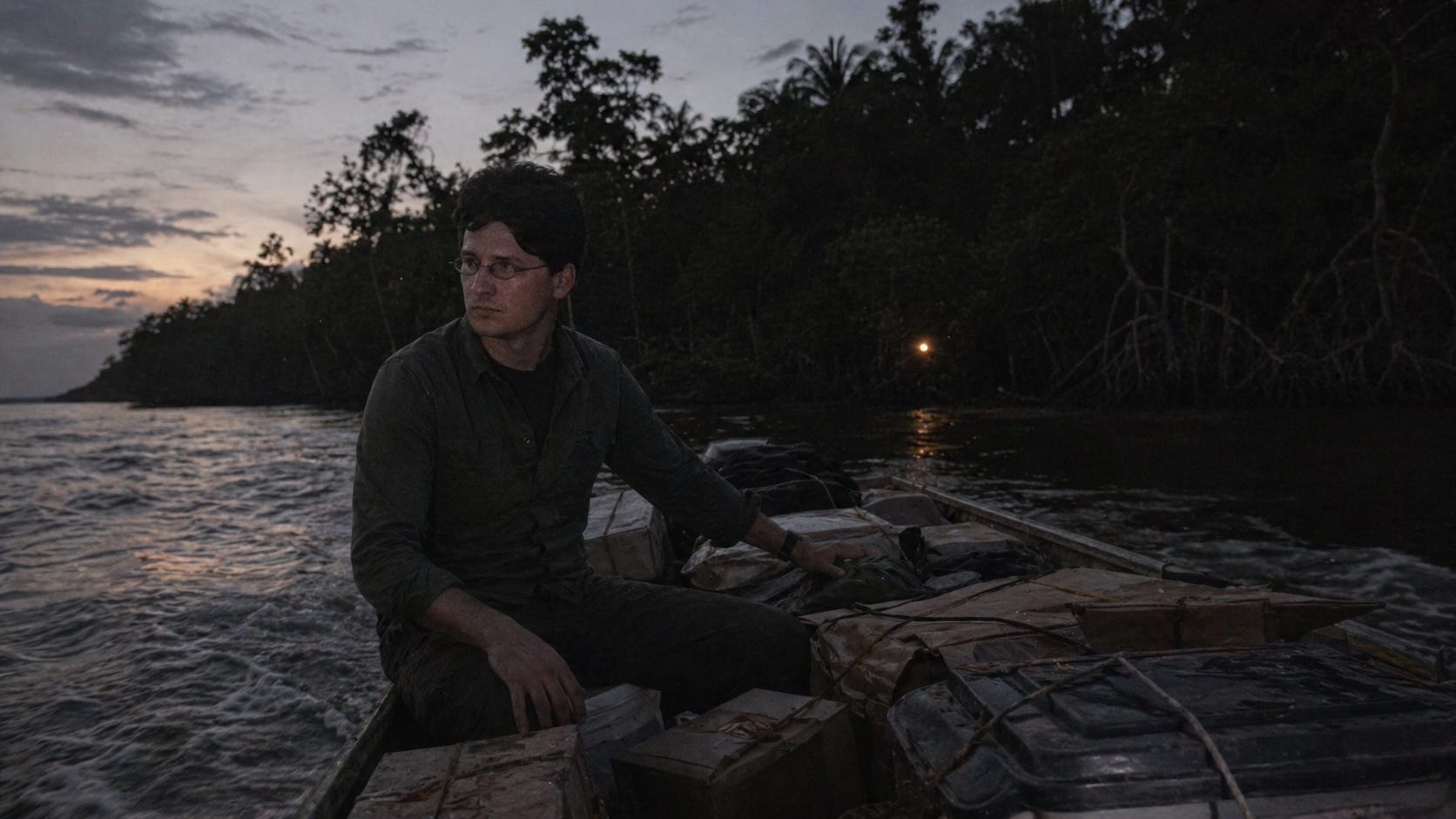
Visual reconstruction: the threshold — mangroves, dusk, fuel, and no guarantee of return.
Daniel Everett entered the Amazon as a missionary and came out with his faith broken.
Kurtz entered the interior as an agent of Western power and became the thing he was supposed to master.
These are not the same story. Everett was not Kurtz. The Pirahã are not Conrad’s Congo. Guyana is not Brazil. The Amazon is not one thing. But the warning stands: the interior is not neutral. It tests the frame by which a person enters. The missionary may arrive with doctrine and discover that doctrine alone is not formation. The operator may arrive with command and discover that command without conversion becomes possession.
I am not telling this because the jungle is exotic. I am telling it because you may one day enter a field you are not trained to survive.
Some places do not merely surround us. They read us. They read fear, hunger, arrogance, innocence, fantasy, lust for power, false humility, and unconverted will. They read the body before the mind has finished arranging its explanations. The jungle is one of those places. It is terrain, but it is also field: biological, psychic, spiritual, tactical, ancestral. Soldiers know the first part. Shamans know more. Missionaries often know almost nothing.
The French Foreign Legion trains men for equatorial forest at the CEFE in Guyane for a reason: the jungle is an operating environment, not scenery.
The missionary version of this training is almost nonexistent.
That is madness.
I did not enter Guyana from a sealed world. I grew up in the Ozarks, where the ordinary surface of things was already thin in places. Certain woods changed when you entered them. Animals knew things before people did. The air could go still in a way that was not merely weather. Farm life had also cured me of sentimental nature. I knew animals as intelligent, dignified, stubborn, and sometimes more graceful than people. I also knew manure, blood, dehorning, slaughter, milk sediment, rabbits screaming when it was time to kill them, and the smell of burnt hair in a shed where I did not want to return for a while afterward. Creation was never a postcard to me. It already had severity in it.
The Ozarks taught me that land could speak.
Guyana taught me that land could devour.
In 1993, on the way into the Guyanese interior, our boat passed near Jonestown. The pilot did not mention it until we were well past. It had the feeling of taboo, not only for Americans. Guyana itself seemed spooked by it, and rightly so. Jonestown was not religious error in some tidy doctrinal sense. It was psychic megalomania in the forest: charisma, spiritual language, isolation, domination, collective capture, and death in the jungle.
Kurtz was not only literary. Guyana had already seen its own form of interior madness.
The interior had already shown what happens when spiritual language, power, isolation, and domination fuse without love.
From there the passage continued inward. Later in the journey, moving between ocean and river systems to reach farther tributaries, we came off rough sea in a metal boat overloaded with supplies. It was a jungle boat, not a sea boat, and it rode too low. Water came in more than once. There was a large barrel of gas in the boat, and the pilot kept tipping it farther and farther back to get fuel. The problem did not arrive suddenly. It built. We could see what was happening.
We were running out.
The man responsible for navigating and protecting us was Amerindian, armed, hardened, and spare with words. He was not nervous. He had mastered enough of that world to move through it with sparse precision. He knew the rivers, the forest, the danger, the practical terms of survival. So when he became serious in a different way, the situation clarified without needing explanation.
We had come off the rough water and tried to cut inland through the mangroves as dusk came on. The tide was going out. The engine died. We worked the paddles, but the boat was too heavy and the water had its own intention. We shouted into the mangroves — practically, urgently, because there was nothing else to do. There was no visible house, no path, no light, no immediate help — only rising panic. Just mangroves, dusk, the tide pulling, and the sea behind us.
We shouted until we were exhausted.
Then a lamp came on where none of us had seen a hut.
An Amerindian man came out of the forest-dark in a dugout canoe. He lived somewhere raised in the mangroves, maybe a fisherman. I never saw the structure clearly. He gave us enough gas to continue.
That was not metaphorical salvation. It was a lamp, a dugout canoe, and fuel.
The jungle introduced itself in stages: Jonestown, ocean, mangrove, dusk, hidden hut, interior. Not symbolism imposed afterward, but sequence. The place was already teaching before I had language for what was happening.
Then the canopy closed overhead.
That was the first time the jungle truly struck me. It was not like entering a forest in North America. It was not a walk among trees. It was a cover, a sealing, a green enclosure pressing downward and inward at the same time. There was nowhere to get out of the boat. Everything beyond the boat was water, mud, root, leech, insect, and whatever else lived under or behind the surface. The field felt hungry and muddy at once, as though it were waiting.
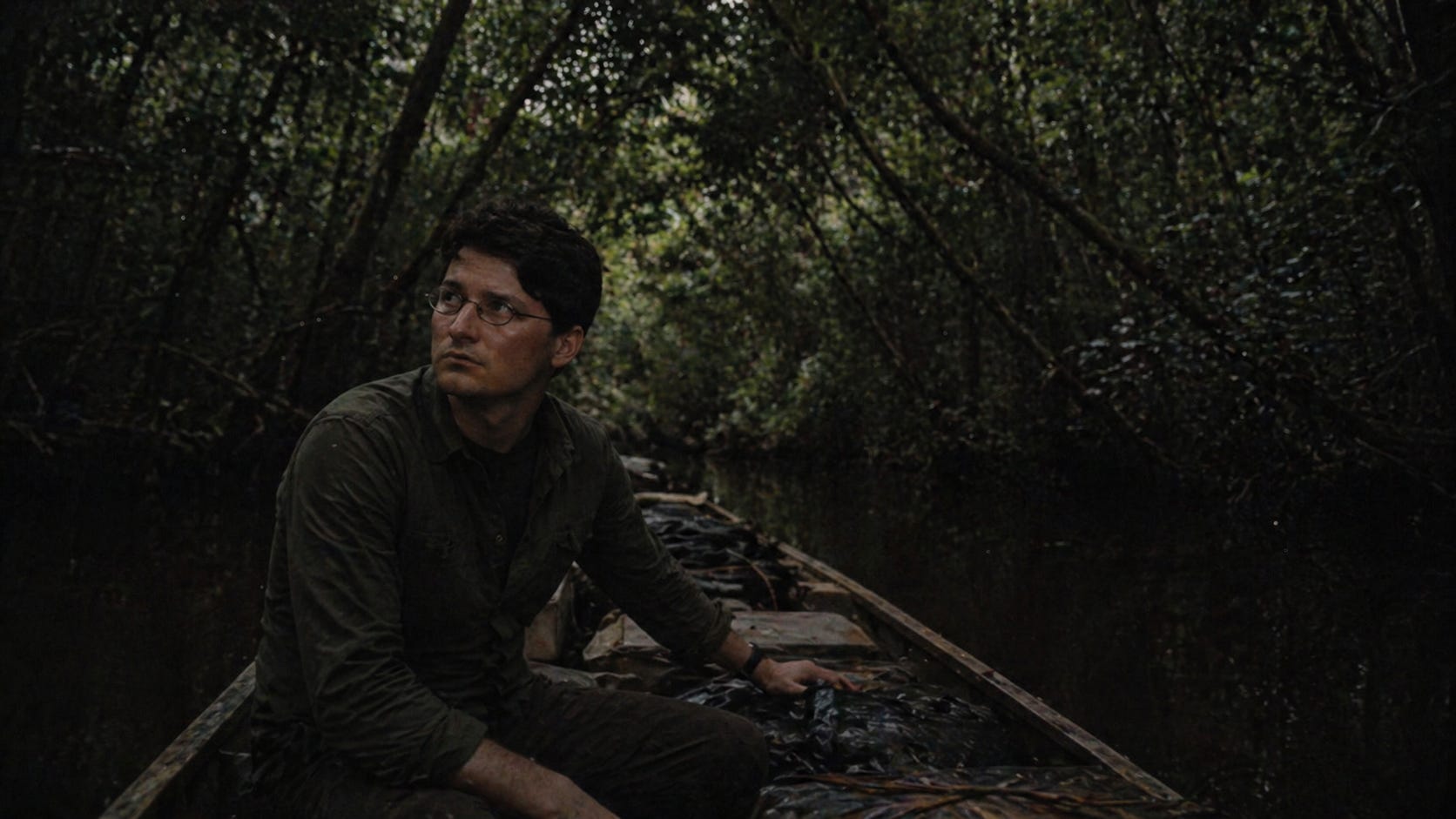
Visual reconstruction: under the canopy, where the river stopped feeling like passage and became enclosure.
I did not know how alone I was until the canopy closed over us. The others were dealing with the practical dangers, and those were real enough: fuel, water, food, insects, river travel, sickness. But I could feel another layer pressing in. I did not have language for it, and I certainly did not have mastery over it. I only knew that the place was alive in a way I had never met before. It was not just dangerous. It was aware, or close enough to awareness that the distinction did not help me.
That is what frightened me. Not the crocs, not even the piranha, not the possibility of pirates. Those were dangers I could name. What scared me was that the jungle seemed to be reading us, and perhaps only the pilot could read it back, and I think he saw me watching too.
Sometimes the cover would break and the boat would push through grasses into sunlight, and for a moment I could breathe. Then the green would close again.
At night, crocodile eyes appeared in the water. The boats rode low. A mechanical failure in the wrong place did not mean inconvenience. It meant exposure. There were piranha. You learned quickly where not to put your hand. The river was not background. It had teeth.
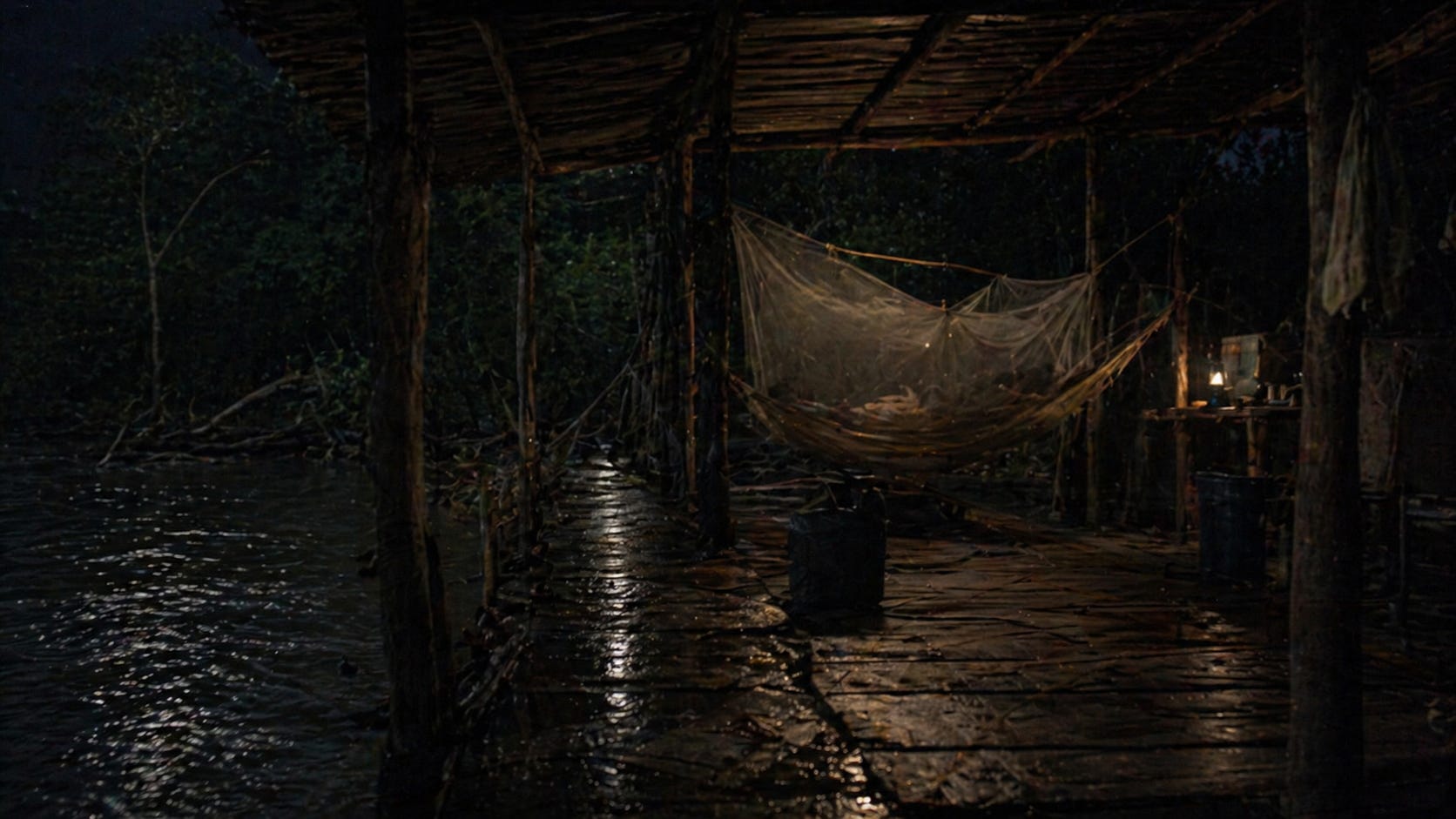
We slept in hammocks under mosquito nets that did not really save us. Mosquitoes got inside anyway, and if you opened the net to let them out, more came in. Eventually you learned to let them feed. They were not delicate mosquitoes. You felt the bite. For years afterward, mosquitoes could still bring me near psychological collapse.
The mosquito net became a lesson in bad containment: open it to free what is already inside, and more enters.
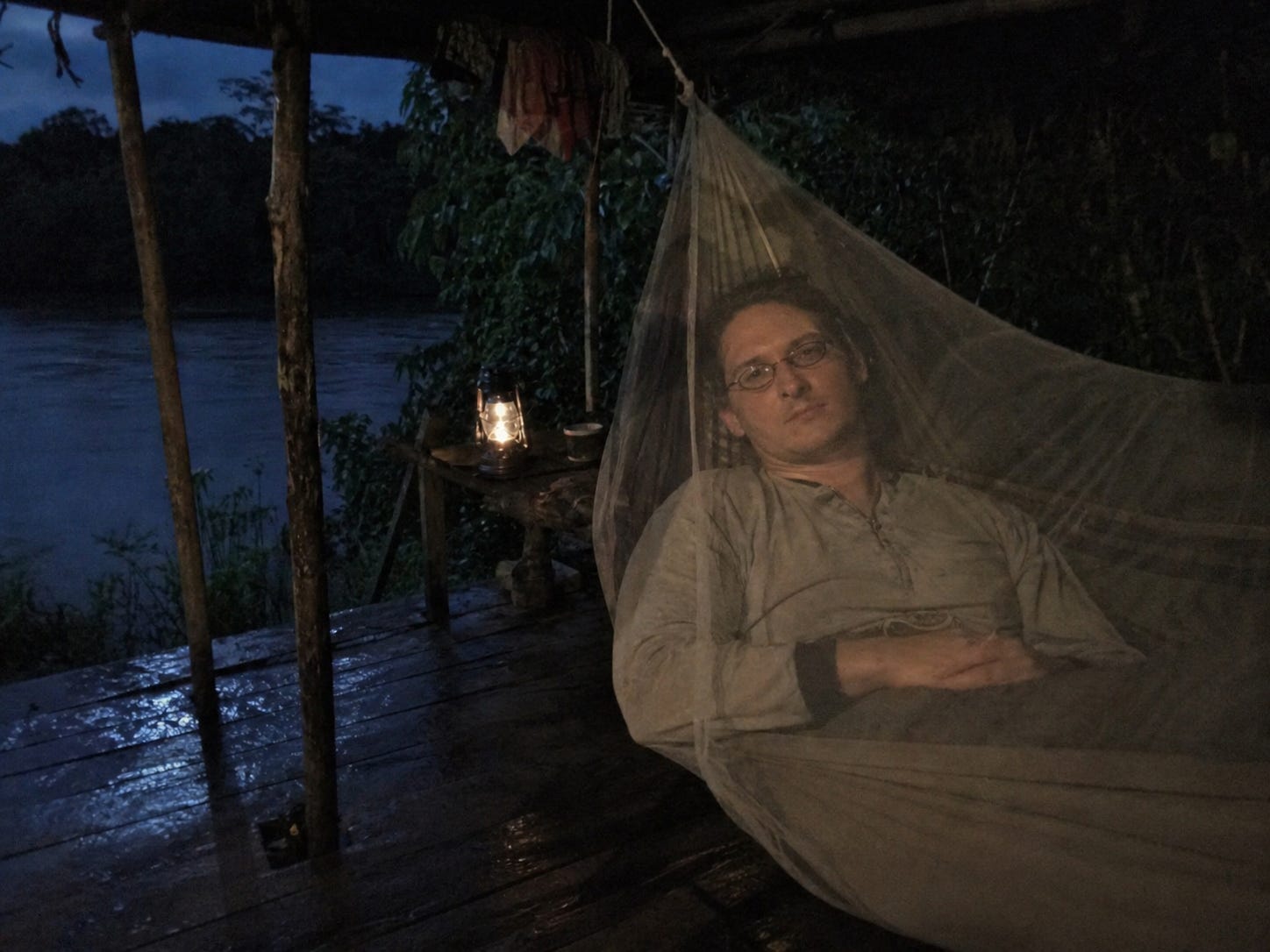
Visual reconstruction: bad containment — wet planks, a net, a lamp, and the river close by.
There were places where we slept near big rivers, with wet wooden pallets leading to covered open structures where the hammocks were hung. In one place I was right by the water, wrapped in the hammock and net like a burrito, knowing that not long before a man had reportedly been eaten by an anaconda in a sugar field nearby. In the jungle, it did not take much for imagination and real possibility to meet.
In raised huts there were enormous roaches or bugs that could crawl into your mouth at night, so you put Vaseline or chapstick on your lips to keep them out. Bread or anything grain-based left exposed could be eaten through by morning. Everything was wet. Clothing had to be chosen with care or one paid for it physically. Humidity entered the folds of the body. Infection, rot, insects, bites, and digestion became part of the spiritual environment.
This is what people miss when they speak too abstractly about nature.
The jungle was beautiful too. Macaws flew over in flocks. There were openings of light, river distances, sudden colors, animal presences, human kindness, and the strange dignity of people formed by a world far harder than anything most Westerners will ever understand. The Amerindian navigator was not romantic scenery. The fisherman in the dugout saved us. The communities had intelligence, humor, endurance, and their own protocols of life. The land had formed them differently, as the taiga formed Dersu Uzala, as sea forms sailors, as desert forms those who can read sand and heat.
But to say that the jungle is beautiful without saying that it can eat you is lying.
I saw a child die of cholera.
That stays. Not as a symbol first, but as a child. Death was not theoretical there. Water was not theoretical. Prayer was not theoretical either, though prayer felt strangely insufficient in that field, at least in the form I then knew. It felt more like psychological self-help than authority. That is not because Christ was absent. It is because the Christianity I carried did not yet have a working interface with that world.
If you are sitting in seminary and think doctrine is enough, do not go.
To minister there in truth, one would have to meet the shaman on his own ground. Not to become him. Not to imitate him. Not to dominate him. But because anything less would not be real in that field. The people might honor the missionary as an outside religious representative, but Christic empowerment is another matter. In that place, soft religion is useless. One needs a high-voltage connection to Christ, deep surrender, cold discipline, and the kind of inner stillness one finds in mountain Zen or the saints. Padre Pio would have understood this better than most missionaries.
You have to collaborate with the jungle, or the jungle wins.
That is the nuance. You do not conquer the field. You do not flatter it. You do not sentimentalize it. You do not enter with contempt. You learn its terms without surrendering your center. The jungle has spiritual antibodies. If you enter wrongly, it knows.
This is what Frontera Verde later helped me recognize. The series is Colombian Amazonian, not Guyanese, and it should not be treated as though one region explains another. But it understood the jungle as a subject, not a backdrop. It understood that the forest is not merely scenery for danger or mysticism. It has guardians. It has memory. It can incorporate. It can empower. It can devour.
The girl in the series does not simply learn about the jungle. Her heart becomes, in some sense, jungle-heart — a beating field of knowing and healing.
That clicked for me because I knew something of the inverse: not proper initiation into the jungle, but hostile contact with it. Not teaching under protection, but field-entry through wound.
The Shamanic Wound
In one village, the chief welcomed me and then offered me either of his two daughters to marry. He was intelligent, charismatic, and calculating. Not heavy at first. Not crude. The village prepared a meal for us, and because we arrived late after difficulties on the waterways, the chicken they had slaughtered had begun to go bad. We ate it anyway. That was the situation. Nothing was optimal, but the visit continued.
The chief was also understood as a powerful shaman. He professed Christianity, or at least held Christian identity in some form, and he was the leader of his village. That matters. This was not a clean contrast between Christian missionary and pagan shaman. In his world, these things were not necessarily separated the way Western categories would prefer. Power, village leadership, Christian language, shamanic force, honor, obligation, family, punishment — all could live in the same person.
When he offered marriage to one of his daughters, I declined.
I did not understand what kind of field I had stepped into. I understood politeness, missionary conduct, moral refusal, social awkwardness. I did not yet understand that a refusal could move through more than one layer at once: personal, familial, tribal, spiritual, masculine, shamanic. I had dishonored him, whether I meant to or not.
The villagers understood more than I did. Later, they came privately and told me to leave quickly. They did not need to spell it out. They said he was a powerful shaman. I understood what they meant.
I left, and the sickness began some days later. It started on the boat, in the rain. By the time I reached another village, it had become full-on: stomach, head, fear, altered perception, a kind of controlled delirium. It was as though I had eaten ayahuasca without choosing it. Something was penetrating me. That is the best word I have for it. It scared me, but because of my earlier field experiences in the Ozarks, I at least understood that what was happening was not ordinary fear.
I wanted out of the jungle. Not because of the crocodiles, not because of pirates, not because of discomfort, but because I knew I was up against more than I could manage spiritually.
I know now that what happened there entered me through the gut. That does not make it less spiritual. The gut is also a center of knowing. What it means is that it landed.
The gut is not merely biological. It is one of the old centers of human knowing: fear, hunger, disgust, courage, violation, instinct, and discernment move there before the mind has finished speaking. The jungle did not enter me as an idea. The shamanic blow did not remain outside me as a belief. It went lower, deeper, into the place where life is digested, resisted, accepted, or rejected.
In Frontera Verde, the girl’s heart becomes a jungle-heart. That is a true image of empowerment through belonging. My experience was different. The jungle did not first open my heart. It struck my gut. It marked the place where the body decides whether something can be metabolized or must be expelled.
For years afterward, I had a sort of morning sickness. Not dramatic every day, not always severe, but there each morning as a small return. One can speak of illness, microbes, stress, or foreignness to the body, but none of that explains the event away. The body was not a distraction from the spiritual reality. The body was where the spiritual reality arrived.
The curse entered my body.
That does not make it less spiritual.
It makes it complete.
I first told the bare version of this in Path of Trinity, in the chapter on the Path of the Spirit, because even then I knew the event belonged to interconnectedness rather than superstition. By Path of the Spirit I mean the stage where a person discovers that life is interconnected not as an idea, but as force: body, field, intention, shadow, dream, illness, and spirit moving through one another. In the original account, I framed the Guyana episode as an illustration of the interconnectedness of all life and as essential to understanding the Path of the Spirit.
The jungle made that unavoidable.
Many Christians want to leap immediately to the Son — love, mercy, compassion, Christ — but without passing through this Spirit-work, that leap can become bypassing. Love becomes mood. Mercy becomes softness. Christ becomes language rather than embodied authority. The Path of the Son must complete the Path of the Spirit, but it cannot be used to avoid it.
Jung understood part of this. The shadow does not disappear because one has Christian language. It becomes more dangerous when baptized but not integrated.
Years later, I learned of Neil Whitehead, the anthropologist whose work on kanaimà and violent shamanic practice in Guyana took him into a dangerous field of its own. He did not remain safely outside his subject. By the end, he took the reality of that world seriously enough to associate his own illness with spiritual attack. A serious researcher was converted by the terrain he studied — not converted to a church, but converted out of anthropological distance and into contact. That matters. This is not a category for tourists, skeptics, or romantics playing with words.
The field converts distance into contact.
A curse is not merely an attack. At a certain level, it is hostile transmission. That is why it is dangerous. It carries intention, field-contact, force, and claim. It enters the person not only as harm, but as distorted knowledge. It presses the victim into the operative reality of the one who sent it.
A clean transmission comes through discipline, permission, lineage, protection, and love. A curse is transmission by violence. It gives without blessing. It marks without consent. It teaches through contamination. But when the claim is broken, the power does not simply vanish. It can be stripped, purified, balanced, and returned under another order. What entered as bondage can become discernment. What entered as sickness can become field-knowledge. What entered as fear can become authority.
The curse did not become transmission because the curse was good. It became transmission because its ownership was broken.
For years it remained partly unassimilated, like a thorn with its own weather. The dark sublime is not a mountaintop view with theological language added later. It is awe with fire ants. Awe with stomach sickness. Awe with crocs under the boat, a child dying of cholera, dusk in the mangroves, fuel gone, a hidden lamp appearing where no shelter had been visible, and shamanic force entering the body before the mind knows what to call it.
The curse taught me that power exists.
The transmutation taught me that power is not final.
Fields That Mark
I know this pattern from another direction too.
During my crime and intelligence analysis training, I worked on active serial killer profiles. This was not abstract criminology. It involved bodies, positioning, behavioral inference, sexual pathology, fantasy structure, escalation, compulsion, and the attempt to reconstruct what kind of pathological development had produced what was done. One has to look closely enough to understand. The imagination has to enter the shape of the violence without consenting to it.
There is a cost to that.
Predatory consciousness has texture. Sexual pathology has atmosphere. A crime scene is not only evidence. It is residue. The analyst may be sitting at a desk, but attention has entered the field. The mind does not come back clean just because the work was legitimate.
I was marked by that work. Later I would call it pollution, but at first it was simply the cost of letting attention enter the field.
This is why I am careful with language like “demonic.” The word is overused, acculturated, and often imprecise, but there are mind-viruses, egregores, pathological fields, predatory spiritual formations — call them what one will — that do not behave like mere ideas. They seek hosts. They recruit through trauma, fascination, shame, erotic distortion, unacknowledged shadow, and the lust to control.
If you work hidden targets — profiling, remote viewing, influence, intelligence, spiritual discernment — do not lie to yourself about contact. Attention is contact. Contact leaves residue.
Good intent does not prevent marking.
Professional legitimacy does not prevent residue.
Work done for protection can still require purification.
A person can enter a field for a good reason and still come back marked. He can enter to help and still be injured by what he contacts. He can enter to see and find that what he saw now lives in him.
Return is not simply leaving the jungle, closing the file, ending the operation, finishing the session, or coming home from the mission. Return means the field has not kept the center. Return means the person can love ordinary life again without contempt. Return means he can cook, wash dishes, care for animals, answer emails, pray, work, rest, and speak gently without secretly needing the voltage of darkness to feel real.
Many people never return.
They keep the jungle unassimilated in their soul. They keep the crime scene in their nervous system. They keep the operation in their will. They keep the curse in their gut. They keep the prophetic accusation in their mouth. They keep the dark field as identity because it made them feel chosen, powerful, wounded, awake.
That is not integration.
That is captivity.
C. S. Lewis saw part of this in Till We Have Faces, though he told it through pagan myth rather than Amazonian field-experience. Orual does not become truthful by avoiding Ungit, the dark goddess in the mirror. She has to see where the devouring sacred already lives in her own possessive love and accusation. Lewis gives Christian readers a pagan initiatory descent and makes them pass through it. Kurtz sees the monster in the jungle mirror and becomes its mouth. Orual sees the monster and is forced toward truth.
That is the difference.
Not denial.
Not worship.
Passage.
The Christic path does not run from the mirror, but it does not kneel to the mirror either. It stands there long enough for the false face to break. To stand in the Christic current is not to become harmless. It is to become governed. Force remains, but it is placed under love. Sight remains, but it is placed under humility. Discernment remains, but it is purified of contempt. Claws remain, but they no longer belong to the ego.
The field shows the claws.
Christ decides what they serve.
Reciprocity and the Four Directions
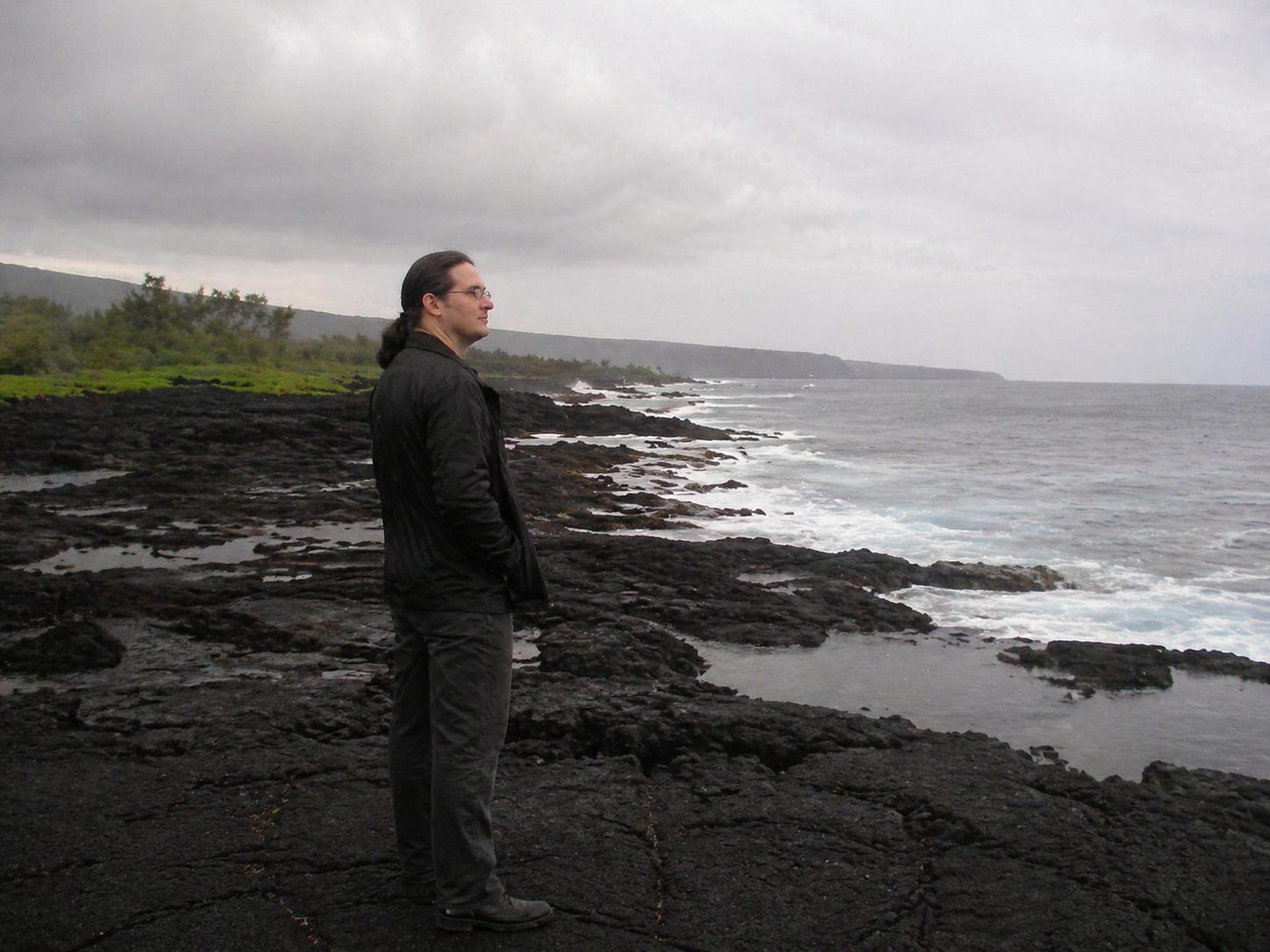
Visual reconstruction from photos: black rock, sea, and another kind of field.
Not every field-contact is hostile.
On Maui, during a difficult period in my life and marriage, I found myself opened to the island in a different way. Stress and dissociation can weaken a person, but they can also make one porous. I went to a sacred site, a place with a longhouse, and the spirits there were real. They were not vague impressions. They came close because they recognized a “live one,” for lack of a better phrase. That is how these things often work. The field notices who can notice it.
The encounters there were positive. The island did not feel like the Guyanese jungle. It had its own severity, but also beauty, reciprocity, and a different kind of welcome. I walked away from the formal site toward a place with a view of the sea, and that was where the charge came more strongly. Not where I expected, not where a sign told me to stand, but where the field opened.
Black rock, sea, sacred land, and the presence of the island were enough.
Pele is not a decorative myth for people who have stood near volcanic force. She is fire, land-making, destruction, creation, and respect. I did not experience her as a concept. I experienced something closer to island presence: not the Guyanese hunger, but fire-memory, sea-air, black rock, and reciprocity.
Later, after my time at the Zen monastery, during the wider awakening that followed, I was taken in a vision to a waterfall. I do not know where it is. It may have been Maui. It may have been somewhere I have never been physically. I only know that I was “made” there somehow. If I ever find it, I am not supposed to tell.
There was nothing un-Christic in this. That is important. The spirits of a place are not automatically enemies because they are not named in Christian categories. Many simply expect reciprocity: respect the land, protect sacred spaces, do not take without giving, do not enter as a consumer, do not pretend the field is empty.
The jungle has reciprocity too, but in a much more dangerous register. So does the sea. So does the volcano. So does the taiga. Dersu Uzala survives because he belongs to a field of reciprocal knowledge. He reads, gives, receives, respects, and knows when the environment is speaking. He is not primitive. He is formed.
This is the point many missionaries miss. A Christian can bring the Christic into a field, but not by pretending the field is empty. Not by trampling protocols. Not by baptizing ignorance as boldness. The field has its own order, its own guardians, its own wounds, its own memory, and its own forms of welcome or refusal.
If Christianity is true, it does not need to be fragile before these realities.
It needs to become deep enough to meet them.
The balancing of the Guyanese wound came decades later, after the curse had lived in me long enough to become part of the structure of my life, and after the awakening that followed my Zen practice opened a far wider field of experience. That period brought angels, orbs, djinn-like presences, Egyptian dream initiations, saints, archangels, and more than I had asked for or knew how to contain. I was not grabbing for experiences. They came. Years later, I am still integrating much of it.
In that wider field, the Siberian shaman dream came.
I described it in Path of Trinity: a Siberian shaman woman performed a ritual and made the sign of the Cross. I understood it then as a Siberian shaman taking away the curse of an Amazonian shaman with the Cross in the four directions.
The language still seems right.
The first shamanic force came through a male village chief in the southern jungle, through honor, refusal, punishment, and heat. The healing came decades later through a Siberian woman in dream, from the north, with cold, distance, grief, and the Cross in the four directions.
The four directions matter. They keep the event from becoming abstract. North, south, east, west: this is older than any doctrinal formula. It is the body in the biosphere, the human being under sky, on earth, oriented within the living world. The sign was Christian, but the grammar was also shamanic and terrestrial. The field was not bypassed. It was marked.
The Cross was not merely imposed on the four directions.
It revealed their center.
The hostile current had entered through place, body, and field. It had to be broken there too. The Cross broke the claim. The four directions opened the field. The power changed masters.
That is the difference between deliverance and amputation. I was not freed because the jungle was made unreal. I was freed because the hostile ownership was broken. What remained could be integrated.
Later, the Siberian shaman came with her own wound-field: images of a woman close to her, perhaps kin, being raped; horses stolen; persecution by the Church. I do not know exactly whether she was living or dead, ancestral or otherwise. Such distinctions are not always easy in the spirit realm. But I understood that reciprocity was involved. She had helped me, and somehow I was being asked to help defend or honor the shamanic peoples and powers that had themselves been wounded, including by Christianity when Christianity became empire, persecution, and fear.
This is delicate territory, but it has to be said. The Cross in the four directions was not permission to despise shamans. It was a demand that power be placed under Christ without lying about the dignity, suffering, knowledge, and wounds of those who carry other forms of spiritual relation.
The hostile shaman in Guyana was real. So was the healing shaman from Siberia. So were the spirits of Maui. So is Christ. I was marked, I survived, I have been helped, I am still integrating, and I am speaking because the stakes are real.
The task is not to flatten these realities into one system. The task is to stand in right relation, with the highest authority governing the whole field.
The Biosphere Has Teeth
The jungle is one face of a larger truth: the Earth’s biosphere has a dark side. Not evil in the tidy moral sense, but dark in the older sense — overwhelming, fertile, devouring, ecstatic, indifferent to human preference, and capable of resetting the terms whenever it chooses.
What happened to Kurtz in the jungle happened to Ahab on the sea. Different element, same exposure. The interior and the ocean both strip the human being down to what is actually there. The sea does not care about civilization’s story of itself. It reads seamanship, nerve, obsession, humility, timing, and the body. Ahab meets the vast living field and mistakes his wound for cosmic authority. The whale becomes his dark mirror, and he cannot pass through it. He binds the crew to his private metaphysical injury and calls it command.
Jungle, sea, desert, ice, volcano — each has its own field-law. Anyone who has spent real time in the jungle or on open water knows this without needing it explained. Especially in an older age, before satellite phones, GPS, emergency extraction, and modern insulation, the elements did not appear as scenery. They were powers. They still are. We have only hidden ourselves from the immediacy.
People speak of Mother Nature as though the phrase were gentle. Often it is not. Mother Nature gives milk, fruit, rain, shade, and breath. She also gives fever, fang, eruption, flood, parasite, famine, and burial.
Awe is not aesthetic appreciation.
Awe is knowing you are not in charge.
Before theology, before metaphysics, before mission, before psychic perception, before symbolic interpretation, there is sweating, hunger, infection, bite, fear, exhaustion, alertness, breath, digestion, survival. That is not a lower truth. It is the first altar of incarnation. Every spiritual claim that cannot pass through this is still incomplete.
The jungle taught this brutally. Bad water entered me. Fear entered me. The curse entered me. Heat, hunger, nausea, vigilance, and prayer all entered the same field. I was not a ghost temporarily inconvenienced by biology. I was body, soul, and spirit under pressure, and the pressure came through the biosphere.
This is why the experience was more Dionysian than Apollonian. Not irrational in the shallow sense, but overfull, vegetative, dangerous, fertile, bloody, and alive beyond measure. Apollo draws lines, clarifies form, illumines distance, separates, names, and orders. Dionysus dissolves the boundary, enters the blood, breaks the mask, intoxicates, dismembers, and returns the person to the living whole. The jungle was not Apollo’s temple. It was green Dionysian force: incorporation, appetite, death, life, rhythm, contagion, and overwhelming nearness.
Christianity has often preferred Apollo, or imagined that it did. Doctrine, light, form, Logos, moral clarity, disciplined ascent. These are necessary. Without them, the soul can dissolve into the field. But Christianity is not only Apollonian. The Incarnation is not an abstraction of light. It is flesh. Blood. Sweat. Hunger. Temptation. Wound. Death. Descent. Resurrection.
Christ does not redeem the world by floating above the body.
He enters it.
That is why the jungle cannot be met by a Christianity that is merely clean, rational, and declarative. The jungle is not impressed by declarative religion. It presses into digestion, fear, sexuality, aggression, illness, dream, and survival. It exposes whether the Logos has become flesh in the person, or whether it remains an idea defended by the mind.
A true spirituality has to be able to stand there: before jungle, sea, volcano, plague, predator, and death, without panic and without arrogance. It has to recover awe. Not decorative awe. Not Instagram awe. The old awe. The kind that bends the neck, sharpens the senses, and makes prayer real.
Only then can love become more than sentiment.
Formation for Dark Fields
If the biosphere has teeth, mission cannot be innocence with a passport.
The older missionary imagination often assumes that the main dangers are external: disease, hostile terrain, cultural misunderstanding, violence, doctrinal confusion, maybe persecution. All of that is real. None of it is enough. The deeper danger is that the person enters a field more powerful than his formation and mistakes survival for authority.
Years ago, when I considered military chaplaincy, a pastor warned me in effect: if you can be anything else, be anything else. Some callings are only for those who cannot do otherwise. He was not discouraging courage. He was naming cost.
Jungle mission, war chaplaincy, profiling, psychic operations, and true spiritual combat belong to that category. They should not be entered for identity, adventure, fascination, or the private need to feel chosen.
A person can survive the jungle and still be captured by it.
A person can come back from the sea and still belong inwardly to the thing that almost took him.
A person can stand before the volcano, feel the living power of Earth, and either receive awe or inflate into private significance.
The question is not only, “What did you experience?” The question is, “What did the experience make of you?” Did it humble perception or intoxicate it? Did it deepen love or sharpen appetite? Did it return you to service or separate you into secret superiority? Did it enlarge Christ in you, or did it merely give the ego a more dramatic mythology?
That is the test.
If you are a missionary, do not mistake warmth for welcome or danger for persecution. The field may be reading things in you your own church never trained you to see.
If you are a soldier, you already know the body learns terrain faster than ideology does.
If you are a psychic operator, do not confuse access with authority.
If you are a Christian, do not try to use the Son to bypass the Spirit. You cannot skip the work of field-awareness, shadow, projection, interconnectedness, and power. Love without wisdom becomes useless. Wisdom without love becomes dangerous. The Son completes the Spirit, but the Son does not excuse us from the Spirit. In Path of Trinity, this same concern appears as the danger of spiritual empowerment without love: wisdom without balanced love becomes spiritually dangerous, and the Path of the Son is the Path of the Heart.
A Christian entering a dark field needs more than zeal. He needs an integrated body, a disciplined imagination, a purified will, a tested prayer life, knowledge of his own shadow, and the humility to leave when the field is not his to enter. He needs to know the difference between courage and provocation, between discernment and suspicion, between spiritual authority and egoic pressure. He needs elders, community, confession, silence, fasting, and return.
He also needs respect.
Respect for the land. Respect for the people formed by the land. Respect for the fact that Amerindian communities are not empty vessels waiting for imported meaning. They have knowledge, protocols, histories, wounds, powers, and forms of relation that Christianity must meet truthfully. Not flatter. Not appropriate. Not condemn from ignorance. Meet.
A missionary who cannot do that may still create converts, but he will not raise the field. He may plant a church and leave the deeper structure untouched. Worse, he may enter the field clumsily enough to injure others and be injured himself.
To bring Christ into such a place requires more than words about Christ. It requires Christic presence: high-voltage connection, humility, courage, discipline, spiritual authority, and love strong enough to stand without domination. It requires the ability to collaborate with the field without being captured by it. That is not soft religion. It is cold mountain discipline with fire at the center.
I am hard on the naïve missionary because I care what happens to him. I care what happens to the people he thinks he is going to serve. I care what happens when spiritual confidence enters a field it cannot read. I have paid for that mismatch in my own body, and I do not want others to mistake sincerity for readiness.
Without return, even real contact becomes dangerous.
Return is not simply coming home geographically. Return means the field has not kept the center. Return means the person can re-enter ordinary life without contempt for it. Return means he can wash dishes, answer emails, love friends, care for animals, pay bills, and not secretly believe he now belongs to a more important reality than everyone else. Return means power has been made ordinary enough to serve.
That may be one of the hardest tests.
The jungle gives intensity. The sea gives vastness. The volcano gives awe. Dark projects give access. Profiling gives terrible insight. Visionary states give permeability. But love must return to the ordinary, or it has not completed its descent.
The Christic path is not only descent into the dark. It is descent and return.
The Cross is not decoration. It is structure.
It teaches descent without possession, suffering without identification with suffering, force without domination, death without finality, return without denial.
For me, the Guyanese jungle was not integrated by thinking about it. It was integrated by surviving it, carrying it, being damaged by it, being forced to deepen, receiving counter-force, and finally placing the power under Christ. That process took years. It may not be finished. But enough has been transmuted that I can say this plainly: what entered as wound became power only when it ceased to belong to the wound.
Otherwise it remains a curse wearing the name of insight.
Mercy with Teeth
The answer is not fear.
The answer is not fascination.
The answer is formation.
The answer is love made strong enough to enter danger without becoming dangerous in the wrong way.
There are places, powers, and conditions that strip away fantasy. The jungle is one. The sea is another. The volcano is another. Violent crime is another. Shamanic force is another. Psychic work is another. Deep prayer can be another. Each reveals something. Each can wound. Each can empower. Each can also deceive the person who mistakes contact for mastery.
I was introduced to the jungle through threshold, danger, death, shamanic force, illness, and long aftermath. I did not understand it then. I understand more now. What entered as wound became empowerment only after it was balanced, transmuted, and placed under Christ. Before that, it was not wisdom. It was a force I carried.
A person can carry power and still not be free.
A person can see and still not be clean.
A person can survive and still not have returned.
The Christic path is not a path of weakness. It is the only path I know by which power can be made safe without being made false. It does not deny the jungle. It does not deny the curse. It does not deny the gut, the body, the field, the predator, the volcano, the sea, the criminal imagination, or the dark goddess in the mirror. It stands before all of it and refuses both panic and worship.
The Cross did not make the jungle unreal.
It broke the claim.
It opened the circle through the four directions.
It made power answer to love.
That is the difference between mission and projection, between prophecy and sorcery, between psychic contact and wisdom, between courage and domination. The world does not need more people intoxicated by hidden power. It does not need missionaries who cannot read a field, operators without repentance, profilers without cleansing, prophets addicted to accusation, or healers who feed on dependency.
It needs people who can enter real darkness and return with the center intact.
People who can see without consuming, act without domination, refuse without hatred, bless without lying, and carry force without making force their god.
The jungle is real. Its powers are real. The body remembers. The gut remembers. The land remembers. The field remembers. Christianity that cannot face this without panic, contempt, sentimentality, or domination is not ready for the fullness of creation.
Love is not refusal of power.
Love is power returned to its rightful master.
Mercy with teeth.
Power under love.
The circle opened by the Cross in the four directions.
Notes and Further Reading
Daniel Everett, Don’t Sleep, There Are Snakes: Life and Language in the Amazonian Jungle. Everett’s account of missionary life among the Pirahã in the Brazilian Amazon is useful here as a missionary-warning text, not as a direct parallel to Guyana.
Herman Melville, Moby-Dick; or, The Whale. Captain Ahab’s pursuit of the white whale is invoked as a sea-parallel to Kurtz: a man wounded by a living power who mistakes his private injury for cosmic authority.
Joseph Conrad, Heart of Darkness. Conrad’s Kurtz is the central literary reference for the European agent who enters the interior and becomes captured by the power he imagined he could master. Francis Ford Coppola’s Apocalypse Now transposes this Kurtzian descent into the Vietnam War, making the same pattern more visually accessible for modern viewers.
The Jonestown Institute. Jonestown was located in Guyana’s Northwest District, between Port Kaituma and Matthews Ridge. It is noted here because passing near it on the way into the interior formed part of the lived threshold of the journey.
The French Foreign Legion’s 3e REI and the CEFE in Guyane provide a useful physical analogy for the kind of hard formation required by equatorial forest. The point is not to militarize mission, but to note that even physical jungle entry requires serious preparation.
Neil L. Whitehead, Dark Shamans: Kanaimà and the Poetics of Violent Death. Whitehead’s work is the most relevant anthropological reference for kanaimà and violent shamanic practice in Guyana.
Netflix / Ciro Guerra et al., Frontera Verde / Green Frontier. The series is used here as an imaginal reference for jungle incorporation and empowerment, not as ethnographic evidence for Guyanese realities.
Olga Kharitidi, Entering the Circle. Useful as a Siberian shamanic / psychiatric encounter text, especially in relation to healing, initiation, and altered ontological frames.
C. S. Lewis, Till We Have Faces. Lewis’s retelling of the Cupid and Psyche myth is relevant for its pagan initiatory descent, its confrontation with the dark goddess Ungit, and its refusal of both denial and worship.
Travis Wade Zinn, “The Invisible Palace: C. S. Lewis and the Christian Reopening of Symbolic Reality.” Further reading for the Lewis line of thought, especially the relation between Christian imagination, symbolic reality, and pre-Christian or pagan initiatory material.
Akira Kurosawa, Dersu Uzala. Used here as a filmic archetype of field-formed wisdom: not romantic primitivism, but mastery through reciprocal relation with terrain.
Hawaiian traditions concerning Pele. Pele is invoked as the Hawaiian volcano deity associated with fire, lava, destruction, creation, and reverence before volcanic land-force.
Werner Herzog, The White Diamond. A Guyana rainforest / Kaieteur Falls documentary useful as a visual and existential companion to canopy, risk, and human obsession before the living field.
Travis Wade Zinn, Path of Trinity: A Journey into Christian Mysticism. Chapter 14 contains the earlier account of the Guyanese shamanic encounter, illness, Neil Whitehead reference, and the later Siberian shaman dream with the Cross in the four directions.
Travis Wade Zinn, “The Stranger Seams of the Ozarks.” Further autobiographical background on place-based awareness and land-initiation before the Guyana experience.
Travis Wade Zinn, “Mythic Recurrence, Place-Memory, and the Unfinished Past in Guy Gavriel Kay’s Ysabel.” Further reading on place-memory, field-based healing, and symbolic recurrence.
Travis Wade Zinn, The Architecture of the Human Spirit: Hegel, Christian Hermeticism, and the Metaphysics of Ascent. Further theological and metaphysical background for the Body/Soul/Spirit and Chronos/Aeon/Aion framework.
Travis Wade Zinn, “Seeing Ahead Without Breaking.” Further reading on anomalous perception, discernment, humility, and the need for containment around psychic intensity.
Additional writings by Travis Wade Zinn are available through his Academia.edu page.
Image note: The jungle and Maui images are AI-generated visual reconstructions based on period photographs of the author and described memories; they are not archival photographs from the 1993 Guyana journey. The essay was edited and developed with dialogical assistance from ChatGPT.
Guyane : la formation la plus redoutée de l’armée française https://youtu.be/jhs2f9q37_M?si=39R9J3ZGFTB0jYP6
Pourquoi la Guyane est un territoire extrême ? - Des racines et des ailes - Documentaire France TV https://youtu.be/e2yTc06OPlo?si=dmks1mGXe7BZOU7f