

“He who sees and hears too much is cursed for a dreamer, a fanatic, or a fool, by the mad mob, who, having eyes, see not, ears and hear not, and refuses to understand.”
— Harold Bell Wright, The Shepherd of the Hills
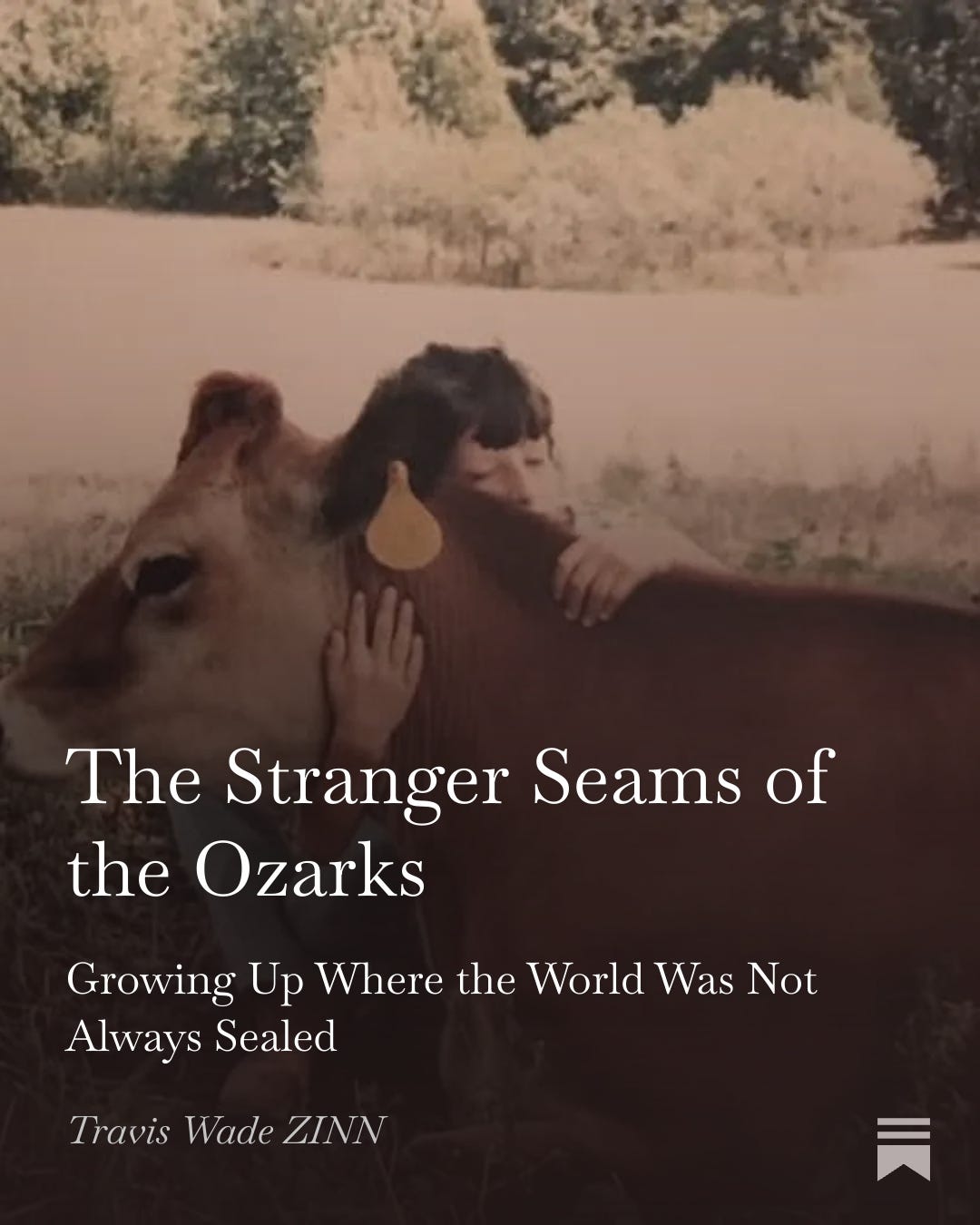
With my milk cow, Angel—West Plains, circa 1985
People know bits and pieces now about Marley Woods, that patch of southern Missouri flap-country where people reported lights, odd encounters, and enough strangeness to make locals lower their voice a little. I’m not claiming Marley Woods explains my childhood. I’m saying I grew up close enough to that country, in what some now call the Missouri Triangle, to know that in those Ozark hills the ordinary world was not always sealed. There were places where the air changed. Animals knew things before people did. Certain stretches of woods could go dead silent for no reason anybody could prove. Call it liminal, psychic, paranormal, or just Ozark reality with less varnish on it.
I knew some of that before I had any theory for it. Once, when I was still young and out in the woods near West Plains with a .410, a bobcat came out and came to up within a couple of feet of where I was sitting. There was no fear in the experience, no jolt, no drama. If anything, it was calmer than ordinary life. My head had gone vacant in a good way, something in my chest was awake, and for a minute or two we were simply there together, mutually aware, involved in the same current. Then it lifted. He moved on. Things returned to normal, except “normal” is not quite the right word. Hypernormal, maybe. More real than usual.
That was the kind of world I grew up in.
First out on CC Highway, about eight miles from West Plains, we lived on a small farm with cows, chickens, rabbits, a huge garden, corn and strawberries, and the sort of life where town was mostly for toilet paper and whatever else we couldn’t grow, barter, can, freeze, fry, or fix ourselves. We went in about once a month. We traded milk for eggs with neighbors. My mother made biscuits and fried deer strips that I still think about. Sometimes she made them on a wood cook stove, which made them even better. It was funny, hard, intimate, and close to the bone. You learned quickly that reality was not clean or theoretical. It had manure on its boots and blood under its fingernails.
Farm life was not fragility culture. You got shocked by fences, cut by wire, stuck by nails, slapped in the face by a cow’s tail when the flies were bad enough to make her swish, and if there was manure on it, well, that too was part of the lesson. But you also learned something most modern people seem determined to forget: closeness is the beginning of respect. Animals were not props, brands, or moral accessories. They had moods, intelligence, dignity, and sometimes more grace than the people handling them.
We had one milk cow, Angel. I milked her by hand. What I remember most vividly is not some gauzy farm-boy innocence, but worrying she’d flick her tail into the pail and ruin the milk. Afterward I’d strain it and there’d still be sediment, sometimes hair, and to this day I never drink the bottom of a jug of milk without thinking of that.
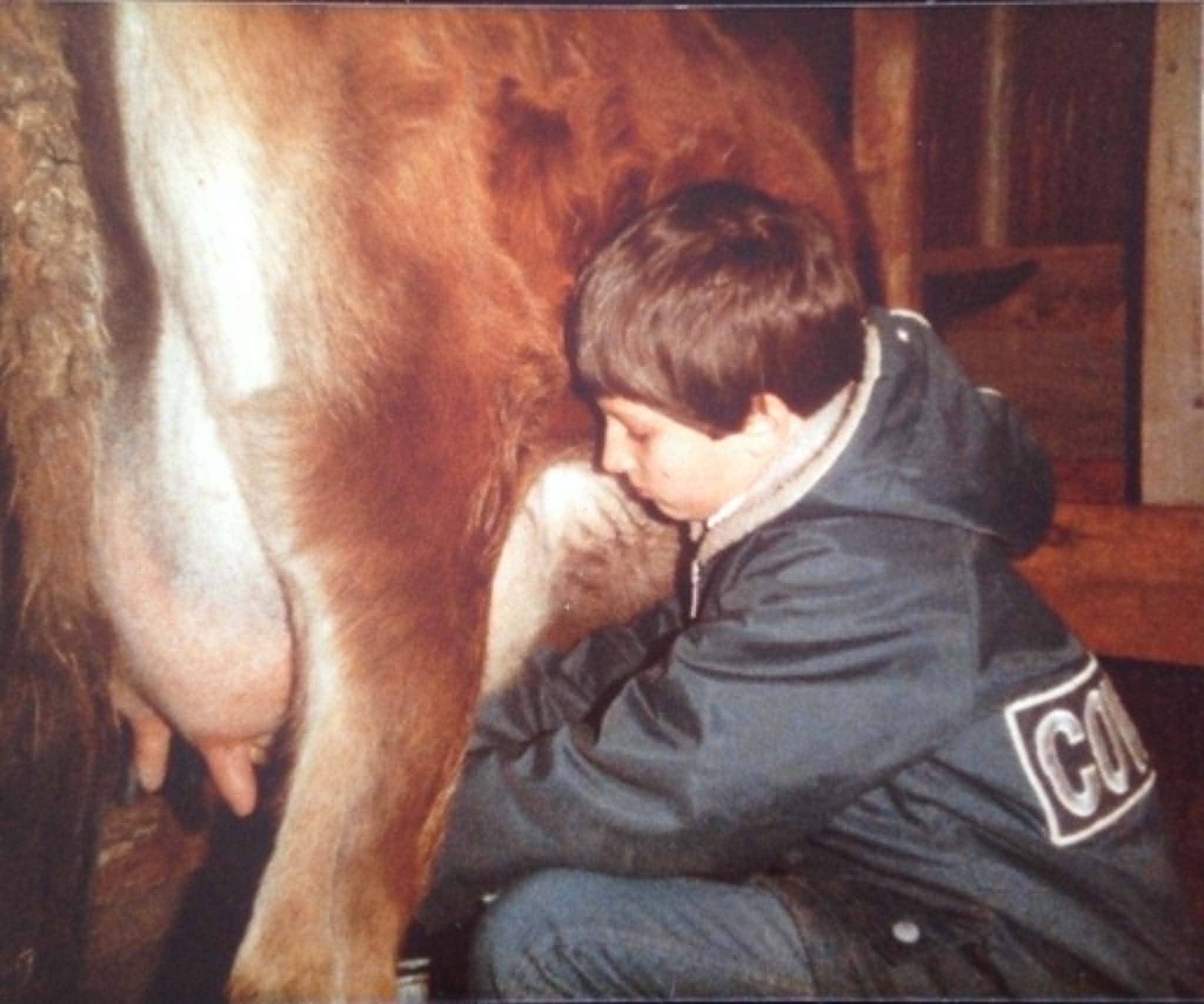
Milking Angel—West Plains
Angel and I had an understanding, formed in the quiet intimacy of that little shed: grain for her, relief for her udder, rhythm, touch, nearness, the kind of routine by which one creature comes to know another. One year we bought a trailer load of half-wild Brahman cattle out of the Louisiana swamps. They were fence-ignorant and full of bad ideas. One day I was trying by myself to herd them into a corral and getting nowhere. Every time I pressed one side, they broke the other. Then Angel came charging up from the lower field faster than I had ever seen her move. At first it startled me so badly it almost threw me off. Then I saw what she was doing. She took the far side and helped me drive them in. Once the calves were penned, she turned and walked back downhill to her grass as if she had simply handled a practical matter and that was that.
Never tell me animals are stupid or unconscious.
That does not mean farm life was sentimental. I remember a bloated cow needing her stomach punctured to let the air out. I remember a steer being de-horned, the iron not catching right, blood on the tin walls, the smell of burnt hair in the shed, and feeling sick over it for days. I remember hating that it had to happen. I remember not wanting to milk in that shed for a while afterward. I remember rabbits squealing when it was time to kill them, and feeling that too. So no, this isn’t nostalgia for some innocent pastoral world. It is simply this: if you live near animals, you learn both tenderness and severity. You learn that everything dies, us too, and that what matters is whether a creature had a decent life, was near to others, and was treated with some respect while it was here.
When I was fifteen we moved to Ava, between there and Mansfield, out on Route 5. I had been homeschooled until then, so this was a threshold in every sense. I started attending Mt. Zion Bible School part-time, a Holiness school filled with good people, earnest and sincere. I dated a beautiful girl named Wendy. She was fifteen and I was sixteen. We rode around in my pickup truck, listened to country music, kissed, and inhabited that whole Ozark world of church, stockyards, horses, hard luck, and unpretentious tenderness.
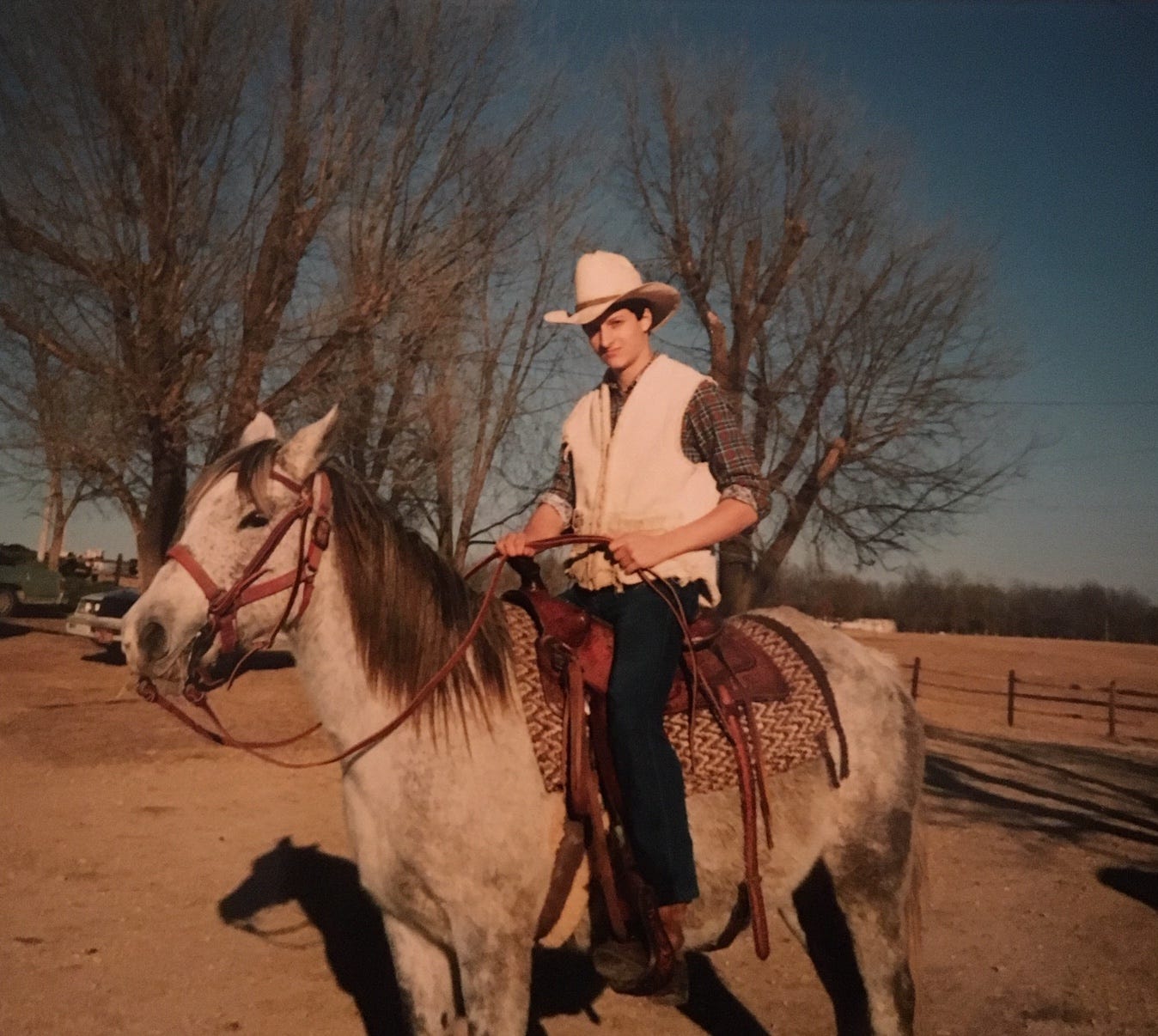
Ava-Mansfield circa 1991
By then I’d also gotten my first real paycheck at the Norwood cattle stockyards, cowboying the entry gate at the auction hall. I was not just some dreamy kid wandering ridges. I knew the smell and sound of cattle country from the inside too. This was Missouri still close to its older grain — Mark Twain and Jesse James country, stockyards and back roads, Bible schools and ridge roads, old currents still near the surface. I grew up just a few miles from where Winter’s Bone was later set and filmed, and it got some of that hard beauty, and accents, right.
That part of the Ozarks had its held spaces. I remember a hoedown in a holler where the house seemed half-built into the hillside and the outside was inside a bit. I don’t remember everything, but what I do remember is the smell: earthy, slightly misted, as if the place had taken the valley into itself. The music was not performed, it just came together organically. Banjo, fiddle, people just showing up because that was what was normal. We kids were warned not to play on the hill because there were poisonous snakes. That, to me, is the Ozarks in miniature: music, danger, hospitality, memory, no pretense. Not a staged authenticity. A living thing.
During those years I also received an invitation to a powwow from the tribe of a friend’s wife and was allowed to sit in the drum circle. That too had the feel of a held reality, not a spectacle but a world entered by intentionally granted permission. Not everyone gets let into certain spaces. That matters. Some realities are not merely observed; they are received, and only under the right terms.
Our place on Route 5 had eighty acres, mostly wooded, with a creek in the valley and two ridges. There were spots on that land that felt set apart. One or two oddly cleared areas within the forest. A certain corner near the upper clearing on the second ridge line. Not always. That matters too. But sometimes, when I reached that area, something shifted. I would set out only to walk the property a while and be back before evening, and then the walk would stop belonging to me in the ordinary way.
My mind did not get foggy. It went the other direction — spare, exact, alert. There was a pull, not quite compulsion, but almost — something like guidance. My mind became more itself. The best word I have for it now is initiatic: a liminal initiation by place. Not fear exactly. Not possession. Not uplift either. More like a bodily-felt charge with direction inside it, and a courage requirement. I was being led, though not in a way I care to fully define.
At one point I remember being pressed toward a patch of blackberry briars when there was an easier route around. For a moment my teenage mind thought in the way teenage minds do: maybe there’s something hidden in there, some explanation that would make ordinary sense. But that was not it. The point was not what might be hidden there. The point was to follow, to listen, and not take the easy route.
That is why the word initiatic comes to mind.
The deeper in I went, the more the place changed. Nearer the destination, the atmosphere changed further. The insects stopped. The wind stopped. No birds. The sky went overcast in that flattened way I still associate with certain states of place. The environment felt contained, slightly pressurized, acoustically changed. Not another world exactly. More like a numinosity of place bodily felt, a different register of the same world. Years later, when Stranger Things depicted the “Upside Down,” I remember thinking: that is not quite it, but the visual intuition is similar. Only this was topside, still the ordinary world, just bent, as if the visible had gone slightly transparent and something behind it had pressed close.
Not everything belongs to public explanation. But I will say this: there were times in those Ozark hills when the land did not feel inert. It felt disclosive. Not always benevolent, not always dark either. Just awake. And if you were willing to acknowledge it, and careful not to force it, sometimes you received something like a blessing you did not fully understand.
Some things were uncanny. Others were simply more reciprocal than people are now taught to expect. A bobcat circling up to me in calm mutual awareness. Melody — not just any dog, but my friend, part wolf, part malamute, part collie — friendly and familiar near the house, then answering some older call in the woods the next, gone for days and then back again. An abandoned frog farm on the property still holding frogs, as if this dedicated space remembered its purpose long after the humans had left. A milk cow exercising common sense better than most people in an office. A hoedown in a holler that felt older than the calendar. A ridge line that could become the edge of initiation.
For readers who have never lived in such a place, that may all sound far-fetched. So be it. I grew up in the Ozarks, and there the world had stranger seams than elsewhere. Poor, hard, sectarian, funny, damaged, beautiful — yes, all of that too. But not sealed. Never fully sealed.
That is not all the Ozarks are. It is only one Ozark world, and not even all of that. But it is real. And for those with ears to hear, there are still places where the old field gathers.
Further Reading
Harold Bell Wright, The Shepherd of the Hills
John Williams, Stoner
James T. Lacatski et al., Inside the U.S. Government Covert UFO Program: New Insights
Further Viewing
A Portrait of the Ozarks Part II
Local Sounds
My dad grew up in Pomona, outside of West Plains. Thanks for sharing this with us.