

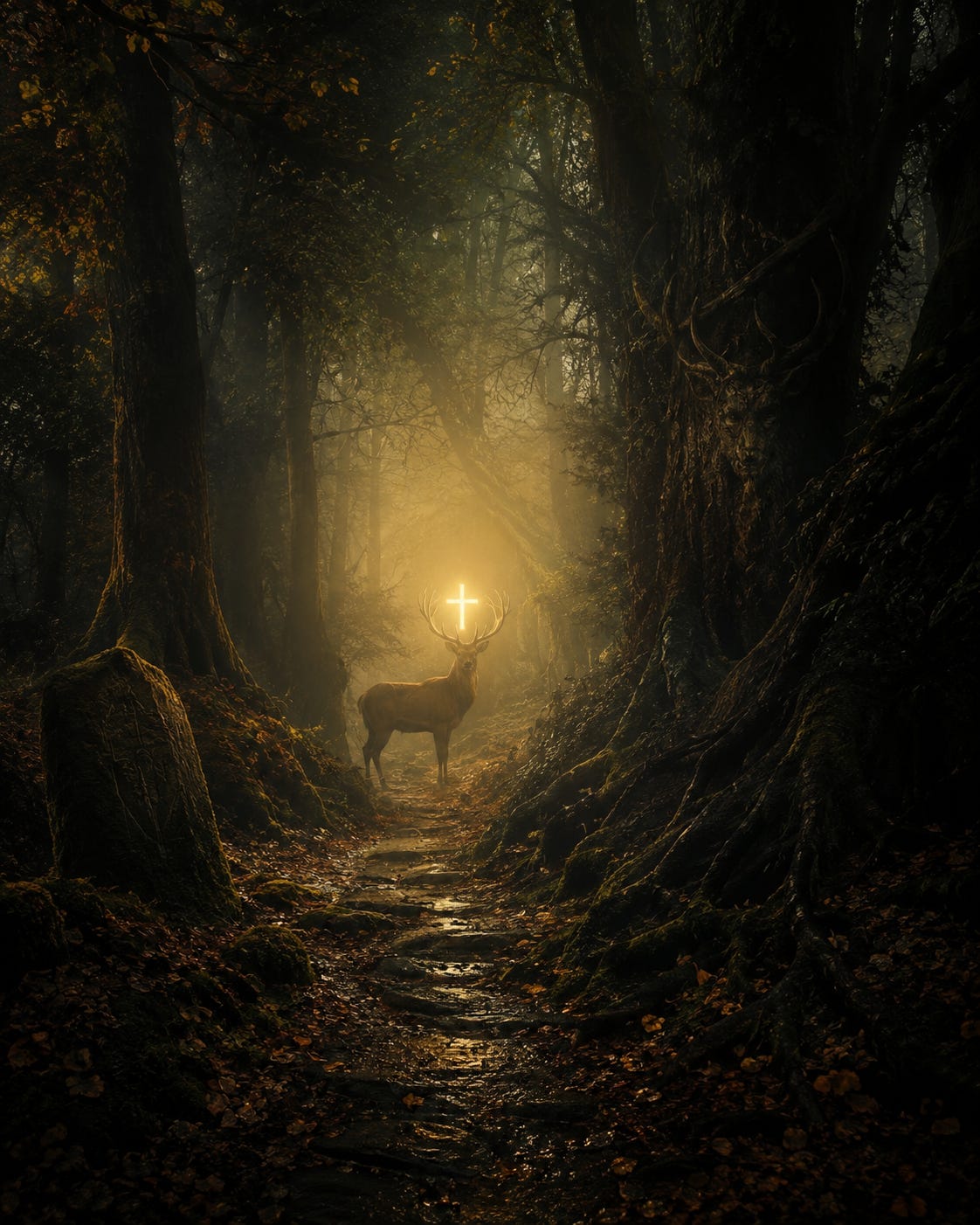
We enter where the green has gone dark.
The branches close behind us. Mud takes the print of the foot. Fern and thorn lean against the path. There is water somewhere, hidden under root and moss. There is the smell of wet bark, old leaves, fungus, animal heat.
No bell.
No candle.
No carved saint.
Only the wood breathing around us.
We go farther in.
A wing breaks somewhere above. A twig snaps and stops us where we stand. The silence is not empty. It listens back.
Here the old world is near.
Not evil.
Near.
The root-world. The blood-world. The place where hoof and hunger and birth and rot keep their own counsel. The place where the beautiful is not gentle because it is beautiful. The place where the soul remembers that creation was alive before we learned to speak over it.
The forest does not speak in sentences.
It speaks by pressure, track, wingbeat, broken twig, the absence of birdsong, the creature that appears and is gone. A sign is given inside another sign, and the soul must learn whether it has been summoned, warned, tempted, or turned.
Something watches from the trees.
Not clearly. Not yet.
A shape at the edge of sight. Antler, shadow, breath. The mind reaches for a name, but the body knows before the mind does: we have come to a threshold.
Do not mock it.
Do not kneel yet.
The forest has doors, and not every door is holy because it opens.
Stand still.
Let the old power pass before the heart without taking the heart.
Let fear rise and fall.
Let wonder rise and fall.
Do not flee from the wild.
Do not worship it.
Wait.
The old stories preserve this knowledge in images sharper than explanation.
One old name that reaches us is Cernunnos: the horned one.
His name is not a label placed over a dead artifact. He is an ancient living symbol, fragmentary yet still charged: antlered, seated among creatures, touched by abundance, root, beast, and underworld. He gathers the forest as power before it has been lifted into mercy.
He does not belong to the clean daylight of doctrine. He stands nearer to the place where power first rises: before appetite has become offering, before fear has become awe, before vitality has become blessing, before the living field has fully yielded itself as blessing and mercy.
We should be careful here. Power is near.
It is too easy to condemn the horned one and turn away. It is also too easy to enthrone him as untouched wisdom. Both moves refuse the work. The first dishonors the dignity of the wild. The second refuses to discern its danger.
The horned threshold asks for something more difficult.
Can we stand before old power without collapsing into panic or reverence?
Can we meet the dark vitality of creation without despising it or surrendering the soul to it?
Can we admit that the world is more alive than our usual seeing allows, while still remembering that aliveness is not holiness?
Depth is not holiness.
Power is not glory.
Access is not salvation.
A door may open in the forest and lead only deeper into hunger. A presence may be ancient and still unhealed. A sign may be beautiful and still bind the soul to fear, secrecy, fascination, superiority, or possession. The wild may be real without being final.
So we wait for the sign within the sign.
And then the stag appears.
Not as conquest.
Not as ornament.
Not as nature broken beneath a higher power.
He stands with the wood still in his body: wet flank, lifted head, dark eye, hoof in leaf-mold, breath in the cold air. He is still wild. He is still himself. He is still able to vanish.
But between the antlers, there is light.
The Cross shines there without burning the creature. It does not break the antlers. It does not bleach the green dark into safety. It does not make the forest harmless.
The stag remains stag.
The forest remains forest.
And yet the old field has opened.
Not into hunger.
Not into fear.
Not into fascination.
Into icon.
This is the strange mercy of the Christian stag.
In the legends of Saint Eustace and Saint Hubert, the hunter enters the forest in pursuit and meets a stag bearing the crucifix between its antlers. The creature is no longer merely quarry. The hunt is interrupted. The world turns. What was being pursued becomes summons. What seemed like animal presence becomes a place of revelation.
But the creature is not erased.
The stag does not cease to be stag because it bears the Cross. Its antlers are not discarded. Its body is not humiliated. The forest is not conquered and dragged into church as a trophy. The wild is not mocked for having been wild.
Something far more delicate happens.
The creature becomes transparent.
The antlers become a living monstrance. The branching crown of the woods bears the sign by which all powers are judged. Not because Christ is one more being inside the forest. Not because the Cross is a charm placed on older forces. But because creation, when it opens rightly, can bear witness to the Logos without ceasing to be creation.
The stag bearing the Cross is not another forest-god.
It is the sign within the sign.
The wild creature opens beyond itself. The antlers no longer close around old power. They bear the light by which power is judged.
The nonhuman is not abolished by Christ.
The wild is not sterilized.
The forest is not turned into a classroom.
It remains forest: breathing, shadowed, dangerous, beautiful, alive.
But now the path appears again.
The horned threshold and the Christic stag are two possibilities of encounter.
In one, the forest gathers as power before transfiguration. In the other, the forest becomes transparent without being destroyed.
In one, the soul stands before old vitality and must decide whether to flee, kneel, or wait. In the other, the Cross appears within the wild and reveals that not all strangeness must end in captivity. The same antlered world that can frighten, seduce, or confuse may also become icon when it no longer closes upon itself.
The Cross does not tell us that every opening is holy.
It teaches us how to see.
A true sign does not inflate the soul. It does not imprison the gaze. It does not feed the hunger to be chosen by hidden powers. A true sign returns us.
Back to the body.
Back to bread, candle, neighbor, wound, prayer, work, mercy.
The stag bearing the Cross does not leave us standing forever in the green dark. It does not make us collectors of thresholds. It does not ask us to worship the forest because the forest is alive.
It gives us the forest back in God.
And then we continue.
We came into the wood where the green had gone dark.
We met the horned threshold.
We waited.
We saw the stag.
Now the chapel bell can be heard.
Not because the forest was false.
Because it was not final.
The stag with the crucifix does not say that the forest has been conquered.
It says that the forest, too, may become icon.
Even the places where we first met fear, hunger, animal power, and shadow may yet become transparent. Even the wild field, when it no longer closes upon itself, may bear the Cross without ceasing to be wild.
The horned threshold asks whether we will worship power.
The Christic stag teaches us to see through it.
Not away from the forest.
Through it.
Toward the One in whom every creature, every sign, every door, and every path is judged, healed, and returned.
Nice writing, Travis. Is this King
Arthur’s White hart? Poesis.