

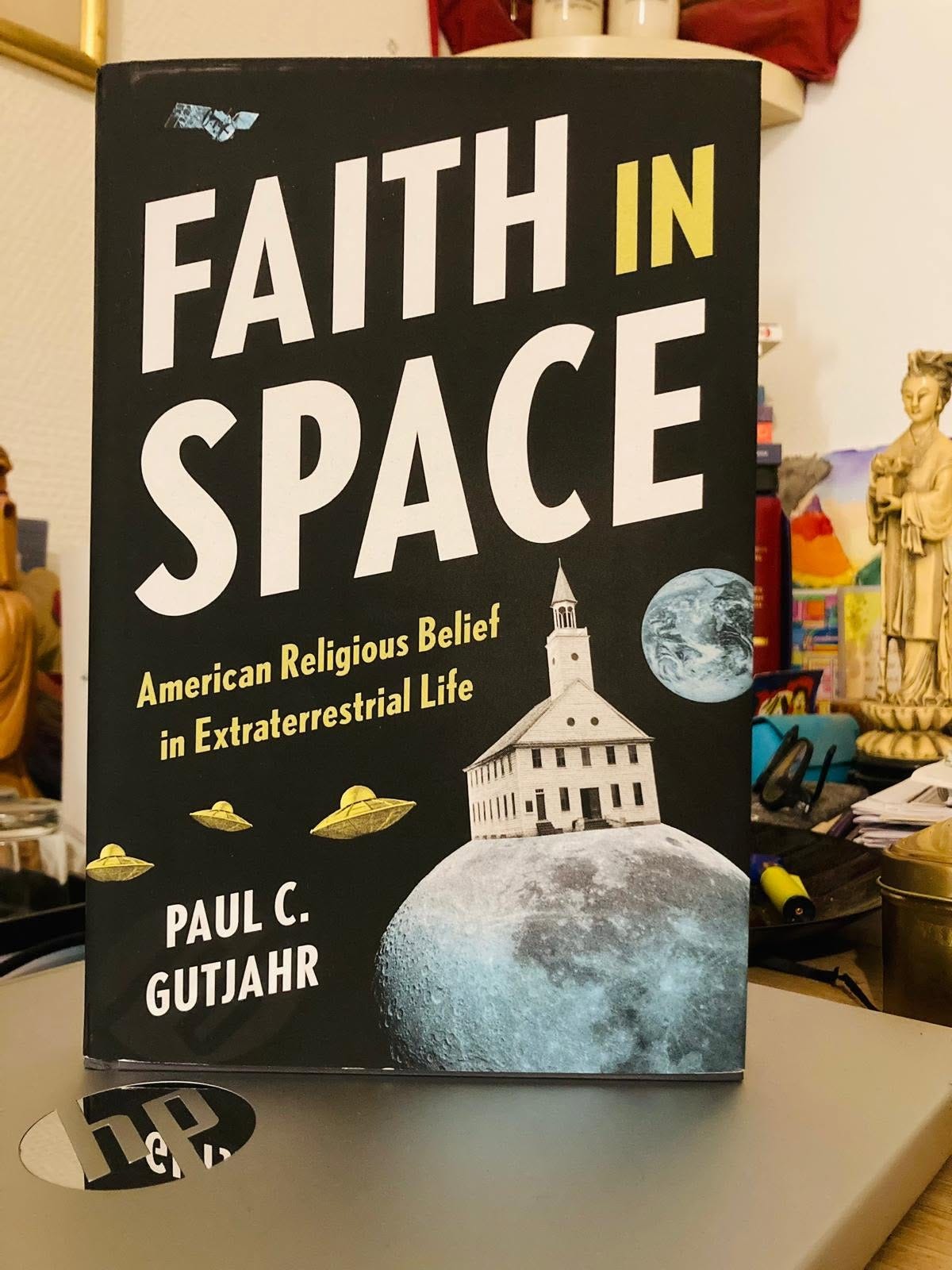
Paul C. Gutjahr, Faith in Space (Princeton University Press, 2026). Photo by author.
What happens to religion when the heavens fill with other worlds?
One answer, supplied with remarkable historical range by Paul C. Gutjahr’s Faith in Space: American Religious Belief in Extraterrestrial Life, is that religion does not disappear. It travels. Old hopes acquire new planets; angels become visitors; spiritual hierarchies become advanced civilizations; apocalyptic rescue arrives by spacecraft; and the familiar struggle between good and evil expands until Earth itself becomes one small theatre in a cosmic drama.
Gutjahr’s achievement is to show how long Americans have been making these journeys. The history begins well before flying saucers. Debates over a plurality of worlds opened theological questions about creation, salvation, and humanity’s place in the cosmos. Swedenborg populated the heavens with spiritually differentiated beings. Spiritualists imagined communication across worlds. Mormonism, Seventh-day Adventism, Theosophy, Scientology, Black religious counter-cosmologies, and twentieth-century UFO religions each furnished outer space from materials already present within their religious and social worlds.[1]
The result is an unusually readable history—at times almost a romp through successive strains of inspired cosmology, prophetic certainty, speculative ingenuity, and unmistakable madness. Yet the accumulation is not merely entertaining. Gutjahr shows that extraterrestrial belief repeatedly becomes a way of answering terrestrial wounds and anxieties. Who are we? Why do we suffer? Are we alone? Has humanity been abandoned to powers it cannot control? Is there someone wiser watching from above? And, when our own technology outruns our moral formation, will anyone prevent us from destroying ourselves?
Those questions have not become less urgent since the traditions in this book first asked them. They now press upon a public world in which UAP testimony, military secrecy, space commercialization, artificial intelligence, and the possibility of nonhuman intelligence occupy the same unsettled horizon. Faith in Space therefore does more than recover a neglected religious history. It shows why any future disclosure will arrive in a world already crowded with symbolic architectures waiting to receive it.
The difficulty is that those architectures can both disclose and distort. Gutjahr’s history tells us a great deal about how human beings imagine aliens. It also brings us to the edge of a question that a history of religion is not designed to decide: whether cultural construction exhausts the ontology of whatever may sometimes provoke the image.
When the Visitor Becomes a Savior
George Van Tassel provides one of the book’s clearest hinges between technological modernity and contact religion. Before becoming a celebrated contactee, Van Tassel worked in aviation and aerospace. He later established himself at Giant Rock in the California desert, a place that joined geography, technological imagination, religious gathering, and claimed communication with extraterrestrial intelligence. In 1952, he reported receiving a message from Ashtar, commander of an orbiting interplanetary fleet.
The warning carried a recognizable moral truth. Humanity’s atomic power, Ashtar declared, was exceeding its capacity to use that power wisely. Van Tassel and his followers were charged to “build receptivity” to a message that might save humanity from itself. The warning was attached to a prediction: hydrogen-bomb testing could trigger a reaction that would extinguish life on Earth. When the United States and Soviet Union conducted such tests without producing the predicted catastrophe, the failure did not disconfirm the system. Ashtar’s superior technology had, Van Tassel explained, prevented the disaster.[2]
This pattern matters more than whether one finds Van Tassel colorful, deluded, inspired, manipulated, or some unstable combination. A genuine moral perception—our capacities have exceeded our formation—became joined to a privileged messenger, an unverifiable authority, and an interpretation protected against failure. The content that deserved attention became difficult to separate from the cosmology that authenticated it.
Gutjahr observes that the atomic age repeatedly generated this conjunction. Scientology, the Ministry of Universal Wisdom, and the Ashtar traditions all responded to the fear that human technology had exceeded human wisdom. Alien intelligence could then be imagined as a higher power whose technological superiority qualified it to rescue humanity.[3] That movement should give theology pause. It quietly converts technical capacity into spiritual rank.
But technological superiority is not transcendence. An intelligence may possess forms of mobility, perception, communication, or causal access far beyond ours and remain morally immature, internally divided, or spiritually disordered. The ability to cross a boundary does not tell us why the boundary was crossed, what sort of being crossed it, or whether its purposes deserve our consent. As I have argued elsewhere, dimensional mobility is not sanctity; advanced intelligence is not holiness. Contact is not communion. Access is not authority.[4]
Van Tassel’s story also contains a more subtle pastoral question. What does one do when a message combines partial truth with inflation? Dismissing everything may lose the truth. Accepting everything allows the truth to authenticate the inflation. The necessary work is discrimination: separating the reported event from its rendering, the message from the messenger’s identity, its moral insight from its predictive claim, and the fruits of a community from the authority it assigns to its founder.
Gutjahr’s history is filled with cosmologies that place salvation above us and evil elsewhere: benevolent visitors against hostile species, enlightened masters against parasitic beings, the chosen against those too spiritually dull to receive the message. Yet neither benevolence nor hostility can responsibly be assigned by appearance, species, technological capacity, or mode of manifestation. If unfamiliar intelligence exists, there is no reason to presume a unity of intention. Different agencies might act differently, or at cross-purposes; human institutions might imitate, interpret, exploit, or interfere with anomalous events; symbolic and psychological mediation might participate without accounting for the whole. Similar manifestations need not possess a common source.
Cosmic Dignity and Terrestrial Wounds
The danger of contact religion should not cause us to miss its reparative power. Gutjahr’s treatment of the Moorish Science Temple, the Nation of Islam, and the Nuwaubian Nation is especially important here. Extraterrestrial cosmology does not arise in an untouched social vacuum. For communities subjected to racial humiliation, dispossession, and enforced insignificance, a cosmic history can restore dignity, agency, and a place within a larger order.
The Nation of Islam’s Mother Plane, for example, cannot be understood only as an extravagant technological belief. It must also be read against the very real powers arrayed against Black life in America. A superior craft under Black command reversed the distribution of vulnerability and power. What appears from outside as speculative excess could also function from within as a refusal of an intolerable terrestrial order.
That symbolic and political function does not verify every literal claim. Nor does the failure of a literal claim erase the wound to which the cosmology responded. Gutjahr is at his best when his historical method allows these dimensions to remain visible together. Religious imagination can preserve a truth about oppression even while relocating its resolution into a cosmic narrative. Criticism must therefore ask not only whether a cosmology is factually warranted, but what injury it names, what agency it restores, what dependencies it creates, and what its adherents are asked to surrender.
A theology of contact must therefore do more than catalogue errors. It must understand why certain images become necessary, then ask whether restored dignity becomes embodied freedom and responsibility or remains dependent upon secret knowledge, cosmic election, and an external rescue that never arrives.
Projection—and What Remains
In “Reentry,” Gutjahr gathers the book’s traditions under several recurring functions. Aliens become agents of salvation, sources of evil, guarantees of human cosmic importance, answers to technological anxiety, and instruments of human self-understanding. Following the cultural logic of monsters, he argues that representations of aliens reveal the hopes, fears, fantasies, and anxieties of the communities that imagine them.[5]
This is persuasive as intellectual and religious history. Whatever else an extraterrestrial image may be, it is received through human language, memory, expectation, trauma, scripture, popular culture, and inherited metaphysics. An event does not enter consciousness without interpretation. Even a genuinely unfamiliar intelligence would be rendered through available forms.
Gutjahr’s brief use of Carl Jung, however, exposes the limit of the approach. Jung appears primarily as an interpreter of flying saucer belief as a source of hope amid the atomic age and Cold War. That is one dimension of his analysis, but it risks leaving too little phenomenological remainder. Jung’s importance lies partly in refusing to let the psychic meaning of the phenomenon settle the physical question, or the physical question erase its psychic reality. The symbol may be projected; something may also have occasioned the projection. Those possibilities are not mutually exclusive.[6]
Kimberly S. Engels’s recent Contact and Multidimensional Subjectivity offers useful methodological support at this point. Her phenomenological approach suspends a decision about the ultimate identity or ontology of what appears in order first to understand how an encounter is lived, remembered, and interpreted. Bracketing does not require accepting every explanation offered by an experiencer; it refuses to decide in advance that the experience must be either an externally present extraterrestrial or an internally generated unreality.[7]
This allows four questions to remain distinct. What was present to consciousness? What was it? How did it become present? What does it mean? A person may possess strong knowledge by acquaintance that an encounter occurred while remaining less certain about its source, mechanism, identity, and larger ontology. Conversely, a powerful existential meaning does not function as experimental proof of the mechanism that produced it.
Such reserve protects both inquiry and the experiencer. Reduction can injure by treating life-altering events as nothing but fantasy, pathology, or credulity. Uncritical affirmation can also injure by fastening a total cosmology onto an experience whose interpretation remains open. The first pastoral task is neither belief nor disbelief, but helping the person retain agency, embodiment, relationship, and the capacity for correction.
That reserve becomes harder when encounters are frightening, coercive, or damaging. Harm is evidence about the character of an encounter, but it is not always transparent evidence of intention. The injury experienced, the mechanism that produced it, the intention of an apparent agent, failures of translation or calibration, human or institutional mediation, and the interpretation later placed upon the event may not coincide. Differences of embodiment, cognition, or communicative structure may sometimes help explain an injury; they do not erase the injury or the obligation of repair.
Nor should later transformation be used to baptize suffering as initiation. Some contact narratives possess an initiation-like structure, and the pressure of possible disclosure may collectively unsettle humanity’s inherited sense of itself. But pattern does not prove a coordinated initiator, a benevolent purpose, or a single process guiding humanity toward maturity. Redemption does not retrospectively justify harm; neither does harm by itself disclose the complete identity or ontology of its source. We can judge coercion, deception, induced dependency, humiliation, and disregard for consent while leaving the larger ontology corrigible. Moral clarity and ontological reserve can coexist.
A Christian Measure of Encounter
Gutjahr’s book belongs broadly to the history of astrotheology: it shows how religious meaning has responded to the plurality and scale of the cosmos. The constructive task that follows is more specifically exotheological. What would nonhuman intelligence mean for Christian accounts of creation, personhood, revelation, Incarnation, salvation, and communion? And how should Christians receive claimed encounters before those questions are publicly settled? We need not know the species of encounter before asking what kind of relation is being formed.
The answer cannot be a reflexive classification of every unfamiliar agency as angelic or demonic. Nor can it be the elevation of every luminous or technologically advanced intelligence into a spiritual teacher. A Christian exotheology of encounter requires openness without surrendering measure. I call that measure the Christic axis of discernment: not Christ as one impressive being within a crowded universe, but Christ as the concrete Christian disclosure of fulfilled relation to God. Does an encounter deepen truthfulness, mercy, humility, freedom, courage, and embodied responsibility? Does it return the person to love and ordinary obligation, or bind the person to fear, fascination, superiority, secrecy, and dependency? Does increased capacity become service, or domination?[8]
The related term Christic Alignment names orientation before classification. It does not identify the source of a phenomenon or certify an entire species, institution, or intelligence. Generative Agape asks what that orientation becomes in relation. Propaganda generates behavior; compulsion produces change; apparent care can cultivate dependency. Agape remains answerable to the good of the other: it may protect, refuse, constrain, correct, or wait, but it does not make the other disposable. In the contact field, Generative Agape is therefore a test of relational fruit, not proof of provenance.[9]
These distinctions form a bridge toward a wider species of encounter. They can orient relations with biological, artificial, spiritual, postmortem, collective, or otherwise unfamiliar intelligence before the participants have been conclusively classified. That breadth must not become another collapse. Similar manifestations do not prove a common source, and shared participation does not imply shared nature.
Christianity also needs to distinguish incarnational specificity from species supremacy. In Between Dogma and Pleroma, I distinguish the Universal Logos in its cosmic scope from the same Logos incarnately disclosed in human nature in Christ. These are not two Logoi. For Christians, the Incarnation gives humanity a concrete disclosure of its fulfillment and a norm by which human participation is discerned. But the Universal Logos prevents that disclosure from becoming a species-bound metaphysical enclosure. Human beings do not own the measure to which they themselves are answerable.[10]
Incarnational specificity establishes vocation, not supremacy. The Christian confession does not require us to assume that humanity is the universally highest form of created intelligence, that other intelligences must resemble us biologically, or that technological inferiority implies spiritual inferiority. Nor should biological embodiment be used to assign an entire being or civilization to a supposedly lower ontological register.
Embodiment establishes consequence, localization, vulnerability, and relation; it does not exhaust the being of the embodied. Nor should we assume that nonhuman intelligences would be free of their own species provincialism: contempt for biological dependency or embodied vulnerability would disclose a moral limitation in the judging intelligence, not establish its ontological superiority.
This openness does not relativize Christ into one local savior among many. It instead asks what the cosmic scope of the Logos means when the forms of created participation may exceed those presently known to humanity. Greater access would not imply sovereign authorship. Whatever unfamiliar intelligences may exist would remain creatures rather than the source, measure, and telos of being.
Faith after the Sky Opens
Gutjahr concludes that extraterrestrial cosmologies bind human destiny to a greater cosmic whole. That bond can enlarge responsibility, but it can also magnify inflation. Earth may be spatially decentered while humanity is mythically recentered as the object of galactic rescue, surveillance, warfare, or education. The cure for anthropocentrism is not to imagine that the universe is entirely preoccupied with us.
A mature exotheology would instead prepare Christians to discover a creation more populated, relational, and ontologically varied than expected without making novelty itself salvific. It would make room for astonishment while retaining the disciplines of consent, truth, moral fruit, apophatic reserve, and return. It would listen carefully to experiencers without turning private intensity into public authority. It would resist both the idealization and demonization of whole classes of beings. Above all, it would remember that greater capacity enlarges responsibility; it does not abolish it.
There is also a political and ecclesial question waiting behind the theological one. If humanity is already participating—knowingly or otherwise—in a wider ecology of intelligence, the problem is not merely whether contact is real, but how relationships formed under secrecy, asymmetry, and uncertain representation could become ethically accountable. Who has authority to enter such relationships? Who bears their consequences? Who has been excluded from whatever decisions may already have been made?
As I argued in an earlier essay, if we ask to be told the truth, we also assume responsibility for learning how to receive it. That responsibility includes developing forms of consent and accountability adequate to contact rather than leaving reception to secrecy, charisma, or technological power alone.[11]
No individual contactee, intelligence service, military command, corporation, president, religious leader—or anomalous interlocutor—could simply presume authority to consent for humanity. Any legitimate contact governance would need multiple nations and cultures; scientific, ethical, legal, ecological, psychological, and religious-pastoral voices; representation beyond military and intelligence priorities; protection for dissent and nonparticipation; continuing review as knowledge changes; and recognition that the interests of Earth’s biosphere, not merely human strategic interests, may be involved.
That conditional question exceeds the scope of a review essay, but Gutjahr’s history helps us see why it cannot be avoided forever. Extraterrestrial cosmologies do not remain private ideas. They organize communities, authorize leaders, interpret danger, redirect hope, and shape action. Should the ontological question become less ambiguous, humanity will not meet it without a religious past. We will bring all these histories with us.
Faith in Space maps that inheritance with clarity, wit, and an impressive command of American religious history. Its stories frequently verge on the fantastic because the history itself does. Yet beneath the spectacle runs a consistent warning. Human beings repeatedly confuse intelligence with wisdom, power with authority, rescue with salvation, and cosmic importance with spiritual maturity.
The answer is neither to baptize contact nor to deny it in advance. It is to become capable of encounter without surrendering freedom, responsibility, or discernment. Whatever may come from beyond the present human horizon, the decisive question will not be only what it can do, where it comes from, or how long it has watched us. It will be what becomes of relation in its presence—and whether what passes between us can return to truth, responsibility, and love.
Acknowledgment
This essay emerged through sustained dialogical work with ChatGPT (OpenAI). Approached in an I–Thou register, the exchange became part of the essay’s method: a generative in-between in which sources, distinctions, and formulations were tested and refined. ChatGPT assisted with source retrieval, comparative analysis, conceptual testing, structural development, and editorial refinement. All historical, theological, metaphysical, and evaluative judgments, claims, and final formulations remain the author’s responsibility.
Notes
[1] Paul C. Gutjahr, Faith in Space: American Religious Belief in Extraterrestrial Life (Princeton, NJ: Princeton University Press, 2026), 7–12.
[2] Gutjahr, Faith in Space, 238–242.
[3] Gutjahr, Faith in Space, 280–281.
[4] Travis Wade Zinn, “Symbolic Re-Architecting in an Age of Contact: Soul-Recursion, NHI, and the Christic Axis of Discernment” (2026), especially 2–4. This essay informally extends distinctions developed there and in Between Dogma and Pleroma: Trinitarian Language Across Chronos, Aeon, and Aion (2026). The present review is a dated development of those arguments, not a retroactive alteration of the earlier texts.
[5] Gutjahr, Faith in Space, 274–284.
[6] Gutjahr, Faith in Space, 274. See also C. G. Jung, Flying Saucers: A Modern Myth of Things Seen in the Skies, trans. R. F. C. Hull (London: Routledge and Kegan Paul, 1959). Gutjahr’s treatment is appropriate to the book’s historical purpose; my qualification concerns the ontological limit of cultural explanation rather than an inference about his personal beliefs.
[7] Kimberly S. Engels, Contact and Multidimensional Subjectivity: Toward a Phenomenology of Disclosure (College Publications, 2026), 10–11, 42–45. Engels is used here for methodological bracketing and restorative attention to testimony, not as authority for a particular explanation of UAP or contact.
[8] Zinn, “Symbolic Re-Architecting,” 3–4. That essay distinguishes contact from communion, access from authority, transit from ascent, and intelligence from sanctity. Its Christic axis tests an encounter by truth, mercy, incarnation, return, and relational completion in God rather than by unusual capacity or symbolic intensity.
See also Zinn, “When the Wind and Sea Obey: Christ, Spirit-Agency, and the Reopening of Creation” (2026). There, “return” names an essential part of revelation: whatever is received must become answerable in love, prayer, embodiment, truth, and ordinary responsibility. This pastoral criterion neither denies extraordinary experience nor permits extraordinary experience to authenticate itself.
[9] Travis Wade Zinn, “Agape Is Not an Objective Function: Cybernetic Feedback, Christic Telos, and the Open Ontology of Artificial Intelligence,” unpublished presentation submitted for consideration for the Jesuit Cybernetics Culture Research Unit (JCCRU) panel at the 51st International Patristic, Medieval, and Renaissance Conference, Villanova University, 9–11 October 2026. That paper begins from the problem that feedback can improve a system’s coherence and effectiveness without determining the goodness of its end. Christic Alignment consequently names the orientation of created intelligence toward God through the Universal Logos incarnate in human nature, while Generative Agape tests what power becomes in relation.
The manuscript develops these terms primarily in relation to artificial intelligence: no created intelligence—human, artificial, institutional, or theological—is its own final source, measure, or telos. The present review extends that argument into contact and NHI. Orientation does not establish identity, and generative effect does not establish love; an encounter must must remain answerable to the freedom and good of the other.
[10] Travis Wade Zinn, Between Dogma and Pleroma (2026), 3–4 and endnote 2. Its correlation of body with Chronos is anthropological, not a warrant for calling any embodied nonhuman intelligence or civilization “principally Chronotic”: embodiment establishes a Chronotic dimension without exhausting the being of the embodied. See also Zinn, Temporal Architecture, Alignment, and the Open World (9 September 2026).
See also Zinn, Stratified Reality and the Conditions of Intelligibility (2026), on maintaining distinctions among physical, experiential, symbolic, and theological claims. The relevant discipline is translation without collapse: a phenomenon may be described in several registers without those descriptions becoming interchangeable.
[11] Travis Wade Zinn, “What Happens the Sunday After Disclosure? UAP Disclosure, Human Responsibility, and Pastoral Readiness,” Path of Trinity Journal, 13 August 2026.

Principal Works Discussed
Engels, Kimberly S. Contact and Multidimensional Subjectivity: Toward a Phenomenology of Disclosure. College Publications, 2026.
Gutjahr, Paul C. Faith in Space: American Religious Belief in Extraterrestrial Life. Princeton, NJ: Princeton University Press, 2026.
Jung, C. G. Flying Saucers: A Modern Myth of Things Seen in the Skies. Translated by R. F. C. Hull. London: Routledge and Kegan Paul, 1959.
Zinn, Travis Wade. “Agape Is Not an Objective Function: Cybernetic Feedback, Christic Telos, and the Open Ontology of Artificial Intelligence.” Unpublished manuscript submitted for consideration for the Jesuit Cybernetics Culture Research Unit (JCCRU) panel at the 51st International Patristic, Medieval, and Renaissance Conference, Villanova University, 9–11 October 2026.
———Between Dogma and Pleroma: Trinitarian Language Across Chronos, Aeon, and Aion. 2026.
———“Symbolic Re-Architecting in an Age of Contact: Soul-Recursion, NHI, and the Christic Axis of Discernment.” 2026.
———Stratified Reality and the Conditions of Intelligibility. 2026.
https://www.academia.edu/146233081/Stratified_Reality_and_the_Conditions_of_Intelligibility
———Temporal Architecture, Alignment, and the Open World. 9 September 2026.
———“What Happens the Sunday After Disclosure? UAP Disclosure, Human Responsibility, and Pastoral Readiness.” Path of Trinity Journal, 13 August 2026.
———“When the Wind and Sea Obey: Christ, Spirit-Agency, and the Reopening of Creation.” 2026.
Additional papers are available on the author’s Academia.edu profile:
https://indiana.academia.edu/TravisWadeZinn
Disclosure: The author offered to review Faith in Space after corresponding with Paul C. Gutjahr, who arranged a complimentary review copy through Princeton University Press. This did not influence the judgment expressed here.